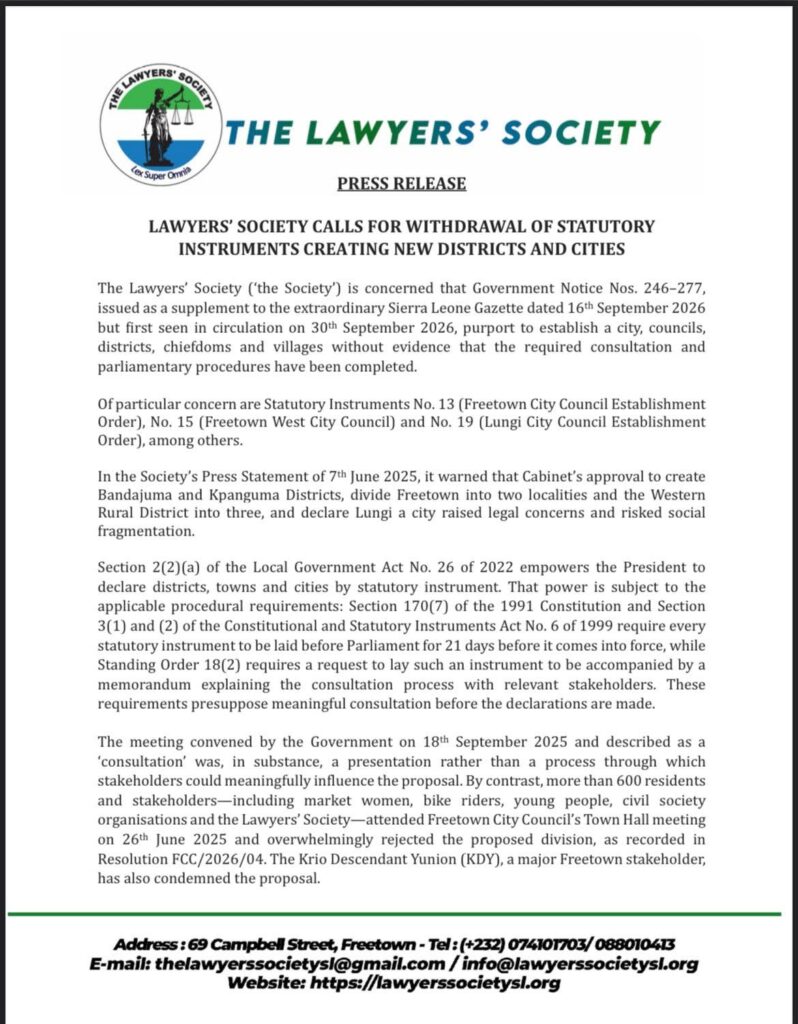

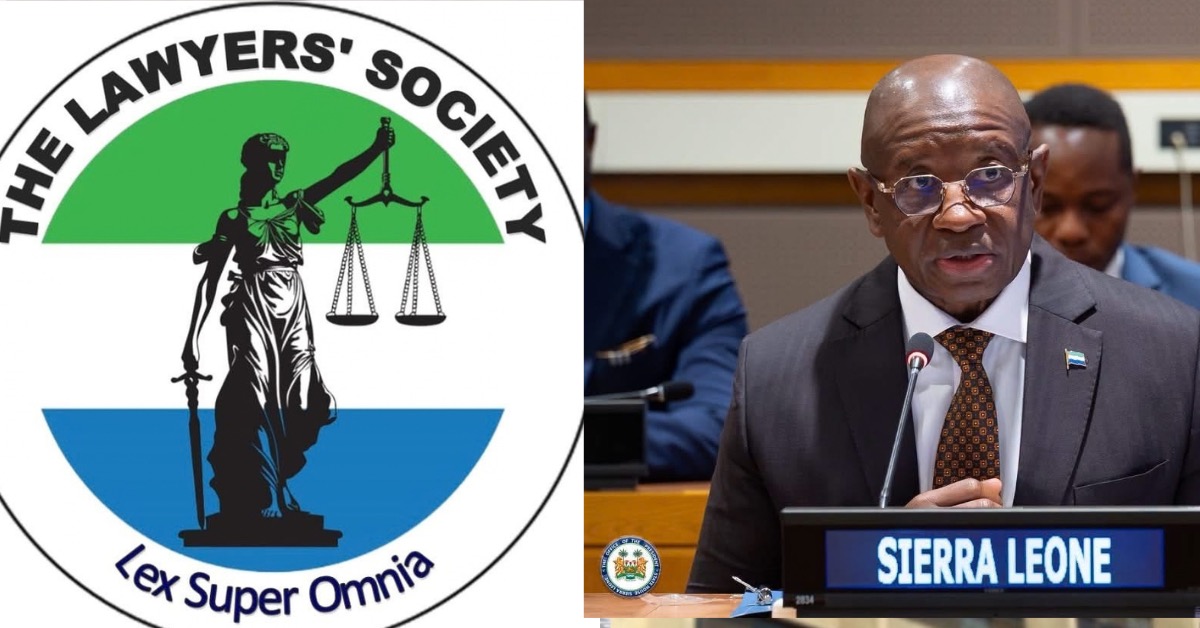
The Lawyers’ Society has called on the Government to withdraw a series of statutory instruments establishing new districts, cities, councils, chiefdoms and villages, arguing that the required consultation and parliamentary procedures have not been adequately completed.
In a press release, the Society expressed concern over Government Notice Nos. 246–277, issued as a supplement to the Extraordinary Sierra Leone Gazette dated 16 September 2026, but which it said only began circulating publicly on 30 September 2026.
The Society specifically highlighted Statutory Instrument No. 13, relating to the Freetown City Council Establishment Order; Statutory Instrument No. 15, establishing Freetown West City Council; and Statutory Instrument No. 19, concerning the Lungi City Council Establishment Order.
The Society said the instruments raise legal and governance concerns because there is, in its view, insufficient evidence that the required consultation with stakeholders and parliamentary procedures have been completed.
It recalled that, in a statement issued on 7 June 2025, it had previously raised concerns over the Government’s plans to create the Bandajuma and Kpanguma Districts, divide Freetown into two localities, split the Western Rural District into three and declare Lungi a city.
According to the Society, Section 2(2)(a) of the Local Government Act No. 26 of 2022 gives the President the power to declare districts, towns and cities by statutory instrument. However, it argued that the exercise of that power is subject to constitutional and statutory procedures.
The Society cited Section 170(7) of the 1991 Constitution, as well as Section 3(1) and (2) of the Constitutional and Statutory Instruments Act No. 6 of 1999, which it said require statutory instruments to be laid before Parliament for 21 days before coming into force.
It also referenced Standing Order 18(2), which requires a request to lay such an instrument before Parliament to be accompanied by a memorandum explaining the consultation process undertaken with relevant stakeholders.
The Lawyers’ Society further questioned the adequacy of the Government’s consultation process, particularly a meeting held on 18 September 2025, which it described as more of a presentation than a process that allowed stakeholders to meaningfully influence the proposals.
The Society contrasted that meeting with a Freetown City Council Town Hall meeting held on 26 June 2025, which it said attracted more than 600 residents and stakeholders, including market women, bike riders, young people, civil society organisations and members of the Lawyers’ Society. According to the Society, participants overwhelmingly rejected the proposed division of Freetown, as reflected in Resolution FCC/2026/04.
It also cited opposition from the Krio Descendant Yunion (KDY), which it described as a major stakeholder in Freetown.
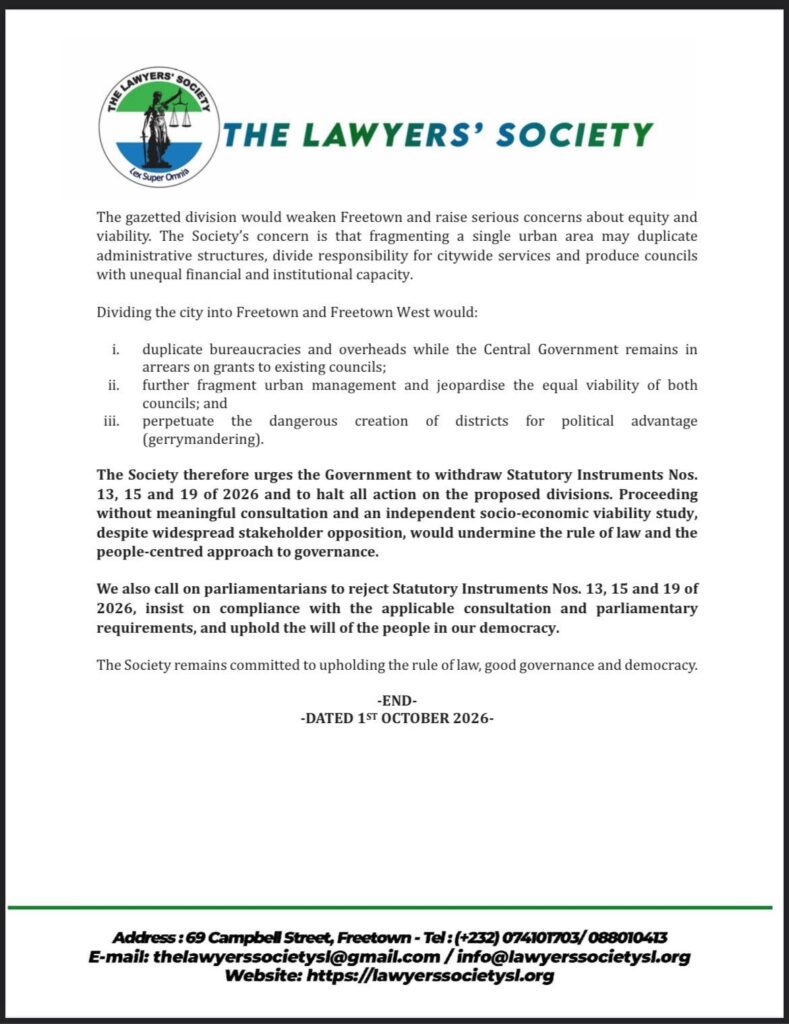
The Society warned that dividing Freetown into Freetown and Freetown West could create challenges for the administration and financial viability of the two councils.
Among the concerns raised are the potential duplication of bureaucratic structures and administrative costs, further fragmentation of urban management and unequal financial and institutional capacity between the proposed councils.
The Society also raised concerns about what it described as the creation of districts for political advantage, referring to the practice as gerrymandering.
It is therefore calling on the Government to withdraw Statutory Instruments Nos. 13, 15 and 19 of 2026 and halt further action on the proposed divisions until meaningful consultations and an independent socio-economic viability assessment are conducted.
The Society has also urged Members of Parliament to reject the instruments and ensure compliance with the applicable constitutional, statutory and parliamentary requirements.
It said its position is grounded in its commitment to the rule of law, good governance and democratic principles.