
By Amin Kef-Ranger
Speaker of Parliament, the Right Honourable Segepoh Solomon Thomas, has defended the constitutional executive powers of the President, arguing that Parliament should not enact laws that restrict the authority of the country’s highest office.
Speaking during the Committee Stage debate on the Constitutional Amendment Bill 2025 on Wednesday, Speaker Segepoh Solomon Thomas told lawmakers that the President remains the supreme Head of State and Government and that the Constitution should reflect the full authority attached to the office.
“Nobody should make law to limit the powers of the President,” Speaker Segepoh Solomon Thomas said, stressing that the President’s constitutional executive authority should not be restricted.
The Speaker reminded Members of Parliament that any political party could assume power and benefit from the constitutional provisions currently being debated. He therefore urged lawmakers to approach the proposed amendments from a national perspective rather than allowing partisan interests to influence their decisions.
“What we do today will apply to whoever is in office tomorrow. We must legislate for the institution, not for individuals,” Speaker Segepoh Solomon Thomas remarked.
His intervention came as Members of Parliament continued deliberations on proposed amendments that could significantly reshape Sierra Leone’s constitutional and electoral framework.
The debate has generated considerable public interest, with discussions focusing on presidential authority, electoral arrangements, democratic representation and the balance of power among the Executive, Legislature and Judiciary.
Supporters of the proposed constitutional changes have argued that the reform process provides an opportunity to address weaknesses in the existing legal framework, improve governance and strengthen the country’s democratic institutions.
However, critics have expressed concern that some of the proposed changes could further concentrate power in the Presidency. They have called for reforms that strengthen accountability, political inclusion, institutional independence and the system of checks and balances.
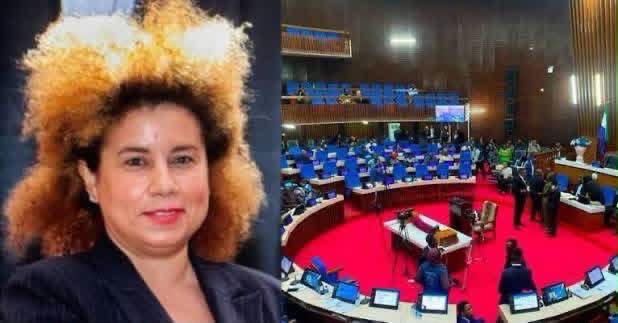
Commenting on the Speaker’s position, Basita Michael, Founder and Governing Officer of the Institute for Legal Research and Advocacy for Justice, said the statement raised important questions about the overall direction of Sierra Leone’s constitutional reform process.
Basita Michael acknowledged that Speaker Segepoh Solomon Thomas and other contributors to the debate were entitled to express their constitutional views. She nevertheless argued that citizens expect the reform process to strengthen the balance of power among the Executive, Legislature and Judiciary.
“At a time when Sierra Leone is debating constitutional reform, citizens naturally expect proposals that strengthen checks and balances between the Executive, Legislature and Judiciary, not interventions that appear to preserve or expand presidential power,” she stated.
Basita Michael also referred to a proposal attributed to Dr. Emmanuel Saffa Abdulai to extend the presidential term to seven years. She maintained that proposals supporting stronger executive authority or longer presidential tenure should be accompanied by measures to increase accountability.
“When proposals consistently point towards stronger executive authority or longer presidential tenure without corresponding increases in accountability, an important constitutional question arises,” she said.
Basita Michael questioned whether the reform process was intended to limit the concentration of power, improve accountability and strengthen checks and balances or whether it would ultimately produce a Constitution that gives greater protection to the Presidency than to the Republic.
The Constitutional Amendment Bill 2025 remains under parliamentary scrutiny, with lawmakers expected to examine its provisions before taking final decisions on the proposed reforms.