
By Usman Fambuleh
The Management of the University of Sierra Leone (USL) has fired a comprehensive broadside at the Anti-Corruption Commission (ACC), formally rejecting key findings of the watchdog’s May 8 report and demanding that the ACC Commissioner instruct the Director of Crimes, Mrs. Evelyn S. Kuyembeh, to issue a public apology and retract the report, which USL says is now circulating publicly in a form that is damaging to the university’s image and the reputations of its independent investigators.
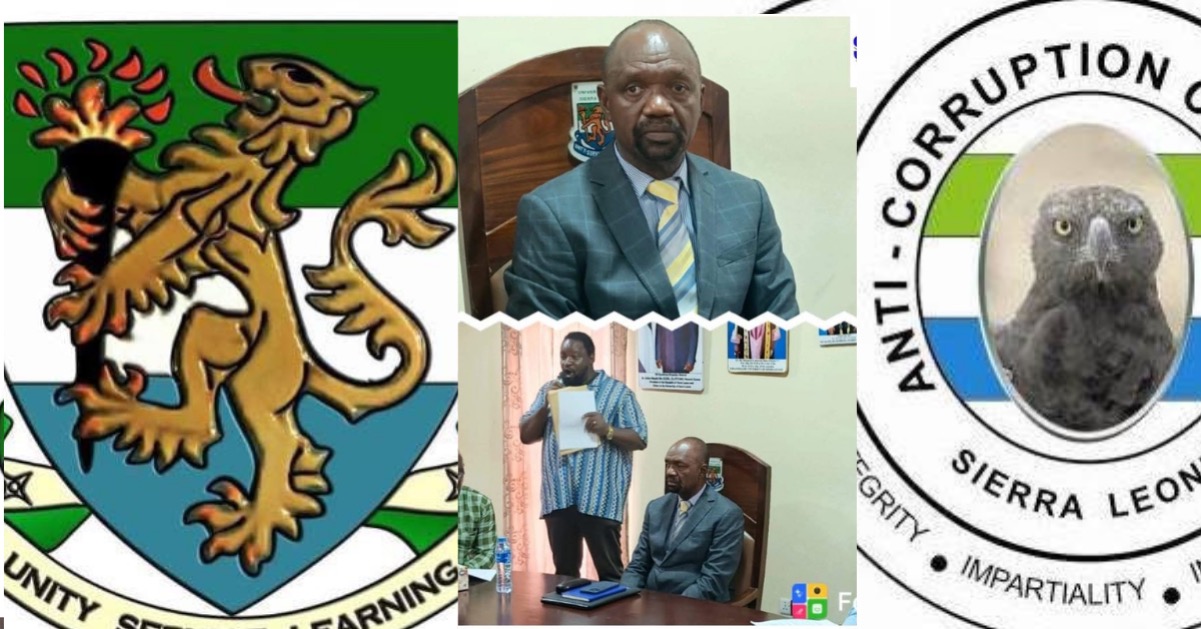
The university’s nine-page Position Paper, reference USL/26, dated 20th May 2026, was presented at a press conference held at Fourah Bay College on Wednesday. Dr. Tonya Musa, Director of Communications at USL, read out the ACC’s findings before the university’s top leadership, the Vice Chancellor and Principal, the Registrar, the Finance Director, the Deputy Vice Chancellor of Fourah Bay College (FBC), and the Deputy Vice Chancellor of COMAHS, publicly signalling USL’s intent to contest the matter at the highest institutional level.
The ACC, through its Director of Intelligence and Investigation Evelyn S. Kuyateh, wrote to the Vice Chancellor on 8 May 2026, presenting findings from an investigation into alleged administrative, financial, procurement, and governance irregularities at USL covering 2021 to 2023. The probe arose from USL’s own 2025 Investigation Committee (INVCOM) and four subsequent subcommittees covering research, policy, financial, and administrative matters.
USL responded twelve days later with a formal position paper that is both a rebuttal and a counter-offensive, accepting some findings while accusing the ACC of material factual inaccuracies, legal misinterpretations, and procedural oversights that, if left unchallenged, would undermine USL’s institutional autonomy and the very principles of transparency the ACC claims to uphold.
On the departure of former Registrar Mrs. Olive K. Barrie and Finance Director Mrs. Waltina Mackay, USL was categorical: both were placed on administrative leave in January 2024 by the Ministry of Technical and Higher Education solely because their five-year contracts had expired. The ACC’s framing that suggested punitive treatment was, in USL’s view, unsubstantiated. Neither officer was accused of corruption, nor dismissed.
On the Business Centre, USL acknowledged the ACC’s point that the Centre, as a private company limited by guarantee, is technically outside the Public Procurement Act. However, USL argued this misses the core governance concern. Its own Court-mandated Policy Sub-Committee found that the Business Centre Manager had engaged in procurement activities entirely outside her mandate, covering computer consumables, office equipment, vehicles and stationery, and that the National Public Procurement Authority (NPPA) had explicitly cautioned USL against this as far back as 2021, a warning that was ignored. The Business Centre had also acted as both supplier and facilitator of procurement simultaneously, creating a direct conflict of interest under Section 33(1)(c) of the Public Procurement Act 2016. USL said it will either bring the Centre under full public procurement oversight or restructure it as a truly independent entity without preferential access to university business.
On procurement more broadly, USL’s position paper revealed that the Policy Sub-Committee, a body independent of INVCOM, operating under the same Court mandate, documented nine specific policy breaches, including the non-existence of a functional Procurement Committee in violation of the National Public Procurement Act 2016, no internal Procurement Policy, improper record-keeping using “Ghana Must Go” bags, an unauthorized vehicle purchase worth US$126,000 that should have gone through International Competitive Bidding, and no Independent Procurement Review Panel. USL Management said it accepts all these findings and has already begun implementing corrective measures.
On research grant management, USL agreed with the ACC that a centralized, university-wide policy is urgently needed. However, the university levelled a pointed accusation against the Deputy Vice Chancellor of COMAHS, Professor Mohamed Samai, alleging he was reluctant to cooperate with the administration’s data collection efforts on research grants, reportedly indicating he was at liberty to spend research overheads as he saw fit because he had personally worked to secure the grants. The Policy Sub-Committee also found the University’s Planning Office and Research Development Services Bureau had been merged and non-functional since 2018, with no governance structure for research coordination, and faculty routinely failing to inform campuses or the Secretariat about research undertaken, including non-payment of the required 10% overhead levy to campuses.
On financial management, USL accepted the ACC’s finding that the Le6.5 billion discrepancy had been previously cleared by the Audit Service Sierra Leone and the ACC itself. However, it drew attention to a significant consequence of the previous administration’s inaction, the Auditor General had written to the Accountant General advising the stoppage of the current Vice Chancellor’s salary for failure to submit financial statements for 2021–2022, periods that predate his tenure entirely. USL said this demonstrates the severity of inherited failures. Additional financial breaches flagged by the Policy Sub-Committee but ignored by the ACC included prolonged payment of retirees’ benefits, retention of unapproved staff and those who had not returned from leave still drawing salaries, and a failure to collect student fees systematically.
On fairness and due process, USL pushed back against the ACC’s criticism of INVCOM’s investigative process, noting that the Policy Sub-Committee, which operated under the same Court mandate but without similar complaints, independently confirmed the same procurement irregularities, thereby strengthening rather than weakening the original findings.
Perhaps the most striking element of USL’s rebuttal is its insistence that the problems at the university are deep, systemic, and predate the 2021–2023 period under investigation. The Policy Sub-Committee identified 17 additional policy irregularities that the ACC did not address, including the abandonment of academic tenure policy for senior lecturers since 2018, the discontinuation of student performance appraisals of academic staff, failure to implement staff attendance registers, and the absence of a Monitoring and Evaluation framework in USL’s policy documents. USL described the ACC’s narrow focus on exonerating individuals while ignoring these structural failures as “incomplete and misleading.”
In its sharpest passage, USL’s conclusion called on the ACC Commissioner to instruct Mrs. Evelyn S. Kuyembeh, Director of Crimes, to issue an apology to USL and retract the report as currently circulating in public. USL argued the report lacks balanced presentation, damages the institution’s image, and undermines the credibility of the independent committee and subcommittee members who carried out the internal investigations.
USL closed with a commitment to implement corrective recommendations from all five internal reports, the INVCOM Report (January 2025), the RESCOM Report (March 2025), the Policy Sub-Committee Report (March 2025), the Administrative Sub-Committee Report (March 2025), and the Financial Sub-Committee Report (March 2025), while respectfully disagreeing with the ACC where it oversteps its mandate or misstates the facts.
The position paper was issued under the seal of the Office of the Registrar and signed by University of Sierra Leone Management.