
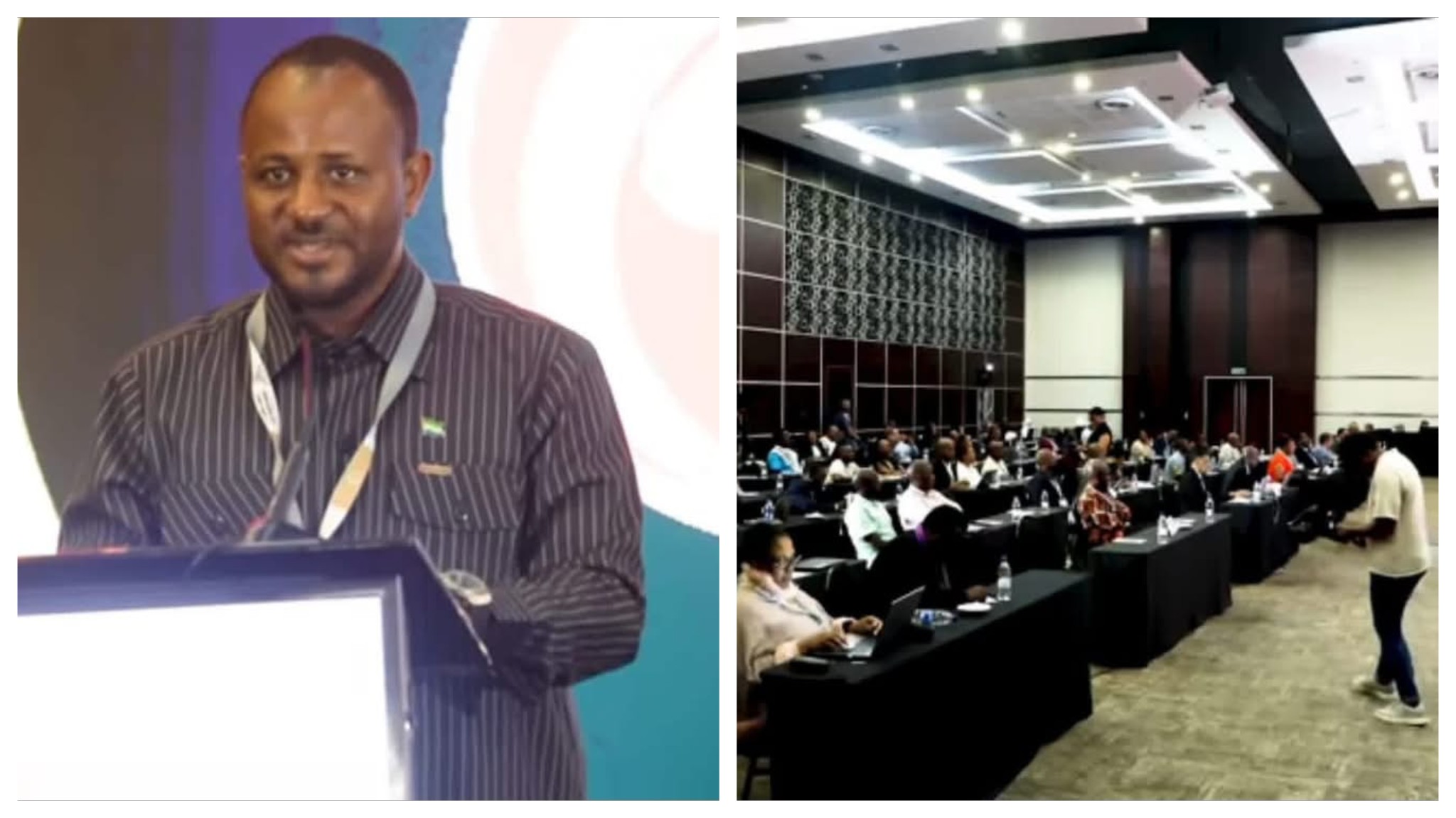
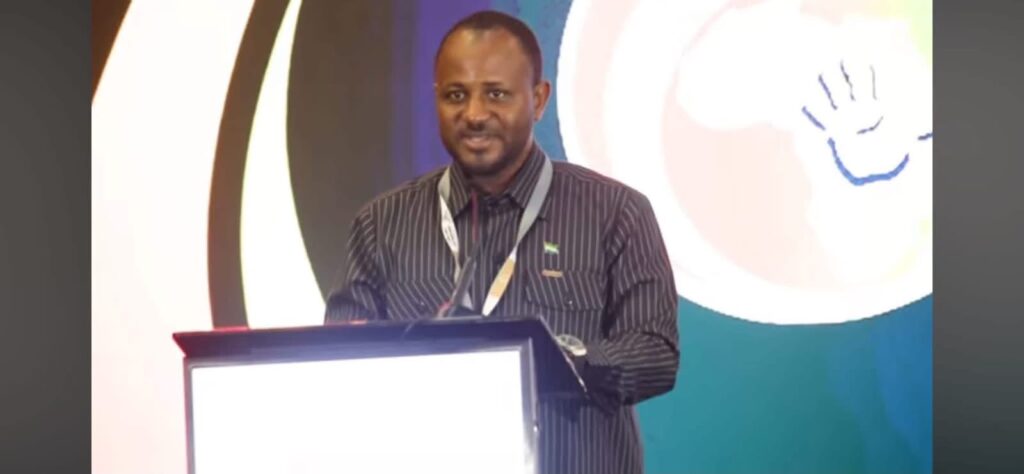
The Member of Parliament for Bombali District, Hon. Ibrahim Barrie, has delivered a keynote address at the 11th Africa Unity for Renaissance Conference, held on November 19, 2026, in KuGompo City, South Africa, where he called on African leaders and institutions to uphold constitutional principles and translate democratic promises into practice.
Speaking on the theme, “The Importance of Constitutionalism in Africa: From Constitutional Promises to Democratic Practice,” Hon. Barrie challenged African governments, parliaments, judiciaries and citizens to move beyond merely having written constitutions and ensure that constitutional provisions are respected and implemented.
He argued that the strength of a democracy should not be judged simply by the existence of a constitution, but by whether those entrusted with public authority exercise their powers within the limits established by law.
Opening his address with an illustration of a country emerging from civil conflict, Barrie described how the end of hostilities, the return of displaced citizens, the organisation of elections and the reopening of Parliament and courts may signal the beginning of democratic recovery. However, he stressed that the real test comes when those in positions of authority are required to respect constitutional limits, particularly when doing so may conflict with their political interests.
He raised questions about whether the Executive would accept limitations on its authority, whether Parliament would exercise oversight without fear or favour, whether the Judiciary would remain independent and whether ordinary citizens would be able to exercise their rights without intimidation or discrimination.
“These are not merely legal questions. They go to the heart of democratic governance and the relationship between the state and its citizens,” he said.
Drawing on his experience as a Member of Parliament in Sierra Leone, as well as his background as an academic and development practitioner, Barrie explained that constitutionalism should be understood as more than a legal concept. He described it as a practical commitment to responsible leadership, institutional accountability and respect for the rule of law.
He distinguished between a constitution and constitutionalism, explaining that while a constitution establishes the legal framework of a state, creates public institutions, distributes powers and protects citizens’ rights, constitutionalism concerns how those provisions are respected and applied.
According to him, a country may have a written constitution, an elected Parliament and a functioning Judiciary but still experience weaknesses in constitutional governance if its institutions are unable to operate independently.
“The real test is therefore not whether a constitution exists, but whether it governs the conduct of those who hold power,” he stated.
Tracing Africa’s constitutional development, Barrie noted that the continent’s political history has been shaped by colonial legal systems, concentrated executive authority after independence, military interventions, restrictions on political competition and disruptions to constitutional order.
He acknowledged that the expansion of multiparty democracy created opportunities for democratic renewal across the continent but cautioned that elections alone cannot guarantee constitutional governance.
“Elections are essential to democracy, but they are not sufficient on their own. Constitutional democracy also depends on independent institutions, accountable leadership, the protection of fundamental rights and respect for the limits of public authority,” he said.
To illustrate the challenges surrounding constitutional safeguards, he referenced Uganda’s removal of presidential term limits in 2005 and the presidential age limit in 2017, alongside Burundi’s 2015 third-term controversy.
He said these developments raise important questions about how African countries can protect constitutional provisions from being weakened by the immediate political interests of individuals and institutions.
Turning to Sierra Leone’s experience, Barrie highlighted the country’s civil war, which lasted from 1991 to 2002, as an example of how institutional weaknesses, exclusion and the breakdown of public trust can undermine national stability.
He said the country’s post-war recovery required more than restoring political institutions. It also involved rebuilding public confidence, strengthening the justice system and establishing mechanisms to address serious human rights violations.
He identified the Truth and Reconciliation Commission and the Special Court for Sierra Leone as important components of the country’s accountability process, demonstrating the role of justice and cooperation between national and international institutions.
“Sierra Leone’s experience reminds us that ending a conflict and consolidating constitutional democracy are related but distinct achievements. Peace must be sustained through justice, accountable institutions, inclusion and credible mechanisms for resolving disagreements,” he said.
He also referenced the more recent Tripartite reform process as an example of how dialogue among political stakeholders can help address disagreements over electoral and governance arrangements.
Barrie maintained that national consensus does not require political actors to share identical views but demands credible processes through which differences can be discussed and resolved peacefully.
During his presentation, he outlined five interconnected pillars of constitutionalism: constitutional supremacy, the rule of law, separation of powers, protection of fundamental rights, and accountability and institutional independence.
He explained that these principles require public officials to operate within constitutional limits, ensure equal application of the law, respect the independence of the Executive, Legislature and Judiciary, protect citizens’ freedoms and allow oversight institutions to perform their duties without interference.
“These principles reinforce one another. Where the judiciary lacks independence, the protection of rights becomes more difficult. Where electoral institutions lack public confidence, democratic legitimacy is weakened,” he noted.
As a legislator, Barrie placed particular emphasis on the responsibility of Parliament to scrutinise government activities and hold the Executive accountable.
He said Parliament’s role extends beyond lawmaking to include representing citizens, debating national priorities, examining government policies and ensuring that public resources are managed in accordance with the law and the public interest.
He highlighted committee hearings, investigations, budget scrutiny and engagement with government ministries as important mechanisms through which Parliament can exercise its oversight responsibilities.
“A parliamentary majority has the authority to govern within the constitutional framework. However, that authority does not remove the responsibility to listen, explain decisions and submit them to scrutiny. A majority is not a licence for unlimited power,” he said.
He further emphasised that opposition voices are an important part of democratic governance, noting that constructive disagreement and parliamentary scrutiny should be recognised as essential elements of the constitutional system.
On constitutional amendments, Barrie cautioned against reforms designed to serve the immediate interests of those in power rather than the long-term interests of the nation.
While acknowledging that constitutions must evolve to reflect changing societies, he stressed that the legitimacy of any amendment depends on both its content and the process through which it is introduced. He identified constitutional procedures, safeguards and public consultation as important requirements for credible reform.
“The question that should guide constitutional reform is straightforward: will the proposed changes leave our institutions stronger, our democracy more inclusive and our constitutional safeguards more secure?” he asked.
He also linked constitutionalism to sustainable development, arguing that the strength of public institutions directly affects resource management, policy implementation and citizens’ access to essential services.
Referencing Sustainable Development Goal 16, which focuses on peace, justice and strong institutions, he said accountable governance is an important foundation for achieving sustainable development.
“Governance is not separate from development. Constitutional governance is therefore not simply a political aspiration. It is one of the foundations on which sustainable development depends,” he stated.

Concluding his address, Barrie outlined five priorities for strengthening constitutional democracy in Africa: respecting constitutional procedures and safeguards, strengthening independent courts and electoral institutions, protecting political pluralism and peaceful competition, improving electoral transparency and dispute resolution, and investing in civic and constitutional education.
He urged African countries to ensure that constitutional provisions guide the conduct of public officials rather than allowing those in authority to manipulate constitutional arrangements for personal or political convenience.
“Let us build an Africa where the Constitution governs those who lead, rather than allowing those who lead to govern the Constitution for their own convenience,” he said.
“The future of African democracy depends not simply on having constitutions, but on having the courage and institutional discipline to live by them.”
The address placed Sierra Leone’s post-conflict experience within the wider continental discussion on constitutional governance, institutional accountability and democratic development.