
At a time when Sierra Leoneans are facing rising living costs and renewed economic pressures, the participation of over 17 government ministers and senior officials in engagements in New York during the 81st United Nations General Assembly (UNGA 81) has triggered questions about the size, necessity and cost of the country’s international delegation.
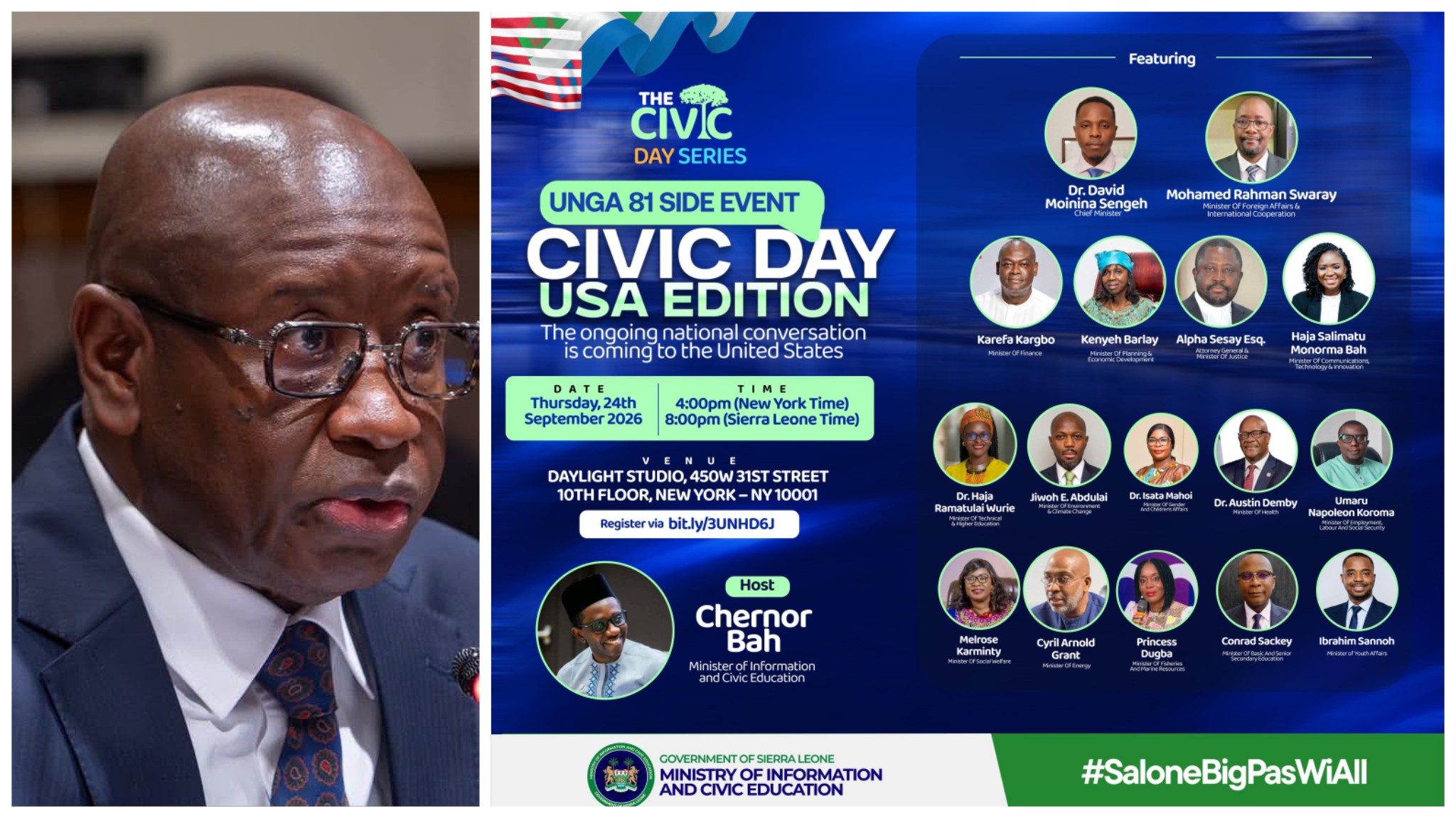
The concerns have gained attention following the publicity for the Civic Day USA Edition, scheduled for September 24 at Daylight Studio in New York, which features a large number of ministers from different government ministries and sectors.
The ministers listed include those responsible for finance, planning, foreign affairs, justice, health, education, energy, environment, communications, youth, social welfare and other areas of government.
The government says the Civic Day initiative is designed to extend Sierra Leone’s national civic conversation to citizens in the diaspora and create a platform for dialogue on governance, development and national issues.
While that objective may provide a basis for the engagement, the unusually large number of senior government officials associated with the New York programme raises a broader public-interest question: was it necessary and cost-effective for such a large number of ministers to be physically present for the engagement?
The question is particularly significant given Sierra Leone’s current economic circumstances.
The National Petroleum Regulatory Authority’s latest published prices, effective September 8, place petrol at NLe40 per litre and diesel at NLe45 per litre, following an increase of NLe5 per litre for both products.
President Julius Maada Bio has acknowledged the impact of international oil-price pressures on domestic fuel and transportation costs, as well as the resulting pressure on inflation.
At a September 2026 development meeting, the President also stressed the importance of fiscal discipline, domestic revenue mobilisation, improved debt management and accountability, while highlighting a US$37 million financing gap for Sierra Leone’s 2026 Population and Housing Census.
Against that backdrop, questions about government expenditure on international travel are likely to resonate with citizens who are themselves being asked to cope with increasing economic pressures.
However, there is an important distinction between questioning the size and potential cost of the delegation and claiming that all the ministers listed for Civic Day travelled to New York specifically for that event at taxpayers’ expense.
The Civic Day publicity establishes that a large number of ministers are participating, but it does not, on its own, establish the individual travel arrangements, airfare and accommodation costs, allowances, or whether every minister travelled specifically for Civic Day.
Some of the ministers may already have been in New York for UNGA-related diplomatic, bilateral or sector-specific engagements.
President Bio, for example, has held several meetings on the margins of UNGA 81, including discussions with the International Monetary Fund on Sierra Leone’s economic reforms and macroeconomic situation.
The wider UNGA programme therefore provides a possible explanation for the presence of some members of the delegation.
But that does not remove the need for transparency.
The public-interest issue is whether government can demonstrate what each minister is doing in New York, why their presence is necessary and what Sierra Leone expects to gain from their participation.
If ministers are holding separate meetings with investors, development partners, international institutions, foreign governments or diaspora organisations, those engagements could be documented and their outcomes communicated to the public.
If some ministers are in New York primarily to participate as speakers or panellists at Civic Day, government could also explain why their physical presence was considered necessary instead of deploying a smaller delegation or using remote participation.
Such information would help the public understand the actual purpose and cost of the unusually large ministerial presence.
The issue comes at a time when the government continues to emphasise accountability, fiscal discipline, coordination and measurable development outcomes.
For citizens, therefore, the concern is not necessarily about Sierra Leone participating in UNGA 81 or engaging Sierra Leoneans in the diaspora.
Rather, it is about whether public expenditure associated with international travel is being subjected to the same standards of accountability and discipline being demanded across the economy.
The Civic Day USA Edition may generate important discussions on governance, development and national issues. But citizens are likely to expect more than photographs, speeches and social-media updates from such a large government presence.
They will want to know how much the delegation cost, why the size of the delegation was necessary, what official assignments were undertaken and what tangible benefits Sierra Leone expects to derive from the engagements.
If the government can demonstrate that the ministers were already attending essential UNGA engagements, that their Civic Day roles formed part of substantive national assignments and that the associated expenditure was properly authorised and controlled, publishing those details could help address the concerns.
Ultimately, the demand is not for condemnation without evidence, but for accountability backed by evidence.
At a time when Sierra Leoneans are confronting economic pressures and government is pursuing fiscal discipline, every major international deployment of public officials should be able to answer three basic questions: How much did it cost? Why was it necessary? And what did Sierra Leone gain from it?