
By: Joy Sarah Y.M. Sawaneh
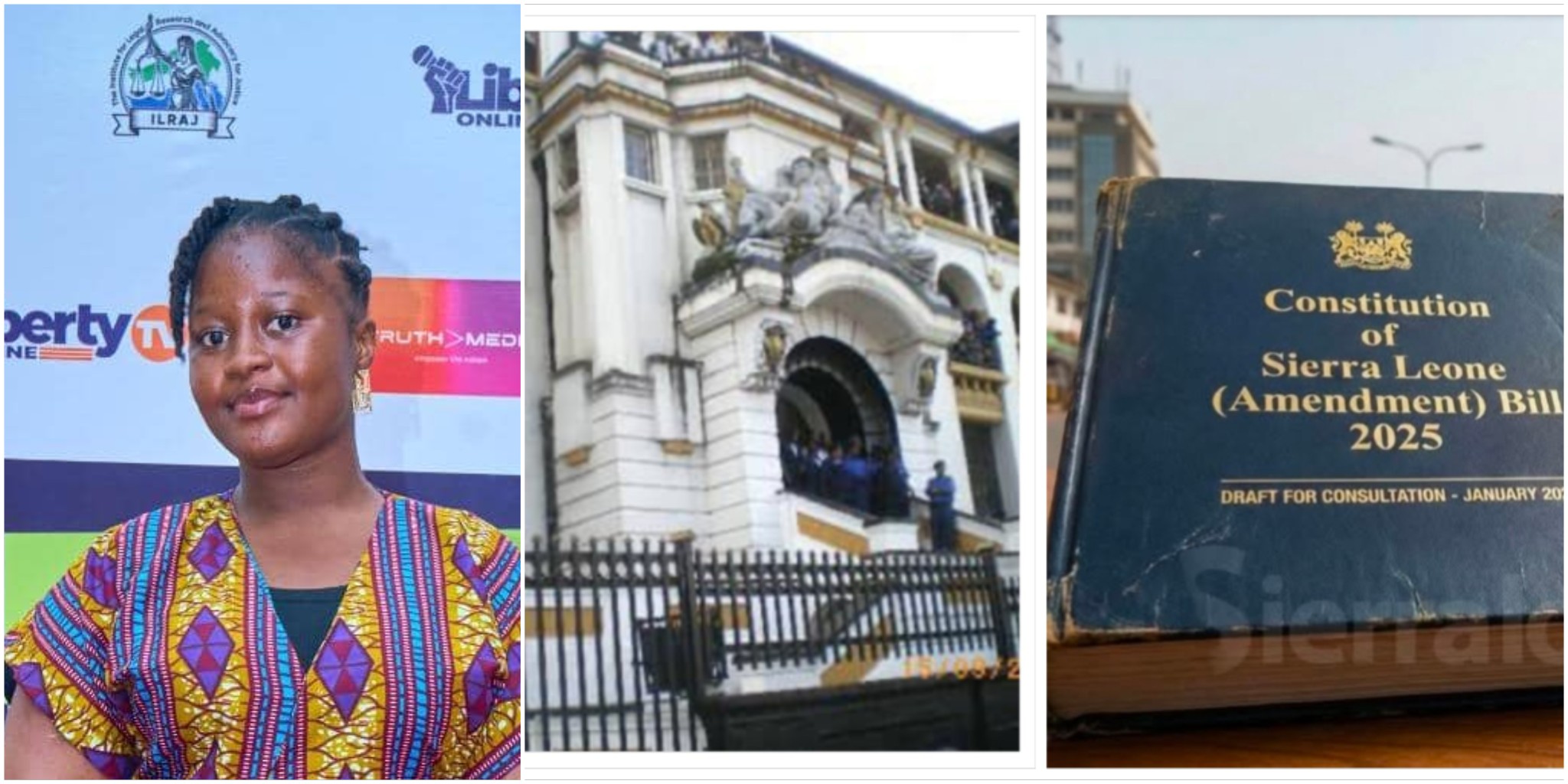
The Constitution of Sierra Leone is the country’s supreme legal framework. It establishes the structure of government, defines the powers of state institutions and sets out the fundamental rules governing the country.
Because of its constitutional status, the process for amending it is subject to specific requirements. One of the provisions at the centre of the current national debate is Section 108(2)(b) of the 1991 Constitution, which provides that a Bill seeking to alter the Constitution must, at its second and third readings, be supported by the votes of not less than two-thirds of the Members of Parliament.
The central question is straightforward but carries significant constitutional implications:
Does “two-thirds of the Members of Parliament” mean two-thirds of the entire membership of Parliament, or two-thirds of the Members present and voting?
The Two Interpretations
The national debate has produced two principal interpretations of the constitutional provision.
One interpretation holds that the phrase “two-thirds of the Members of Parliament” refers to the entire membership of Parliament. Under this interpretation, the required constitutional threshold would remain fixed even if some Members were absent from the sitting.
Parliament currently has 149 Members. Two-thirds of that number is 99.33, meaning that 100 affirmative votes would be required to meet or exceed the threshold if the calculation is based on the full membership.
The APC has publicly advanced this interpretation in challenging the parliamentary proceedings of August 10, 2026.
The opposing interpretation focuses on the general parliamentary rule contained in Section 91(1), which provides that, except where the Constitution provides otherwise, questions before Parliament are determined by a majority of Members present and voting.
From this perspective, the voting threshold in Section 108(2)(b) should be considered alongside Section 91(1), raising the question of whether the relevant calculation should be based on Members actually present and voting at the time.
The disagreement, therefore, is not about whether two-thirds represents approximately 66.7 percent. Both sides accept the mathematical meaning of two-thirds.
The central question is:
Two-thirds of whom?
The 149-Member Question
The size of Parliament has become an important part of the debate because the two interpretations can produce significantly different voting thresholds.
For example, if 90 Members are present at a sitting, the question becomes whether the constitutional requirement should be calculated against all 149 Members or against the Members present and voting.
Under the full-membership interpretation, the threshold remains tied to the total membership of Parliament.
Under the present-and-voting interpretation, the number required would vary according to the number of Members participating in the vote.
This is why the dispute is not simply a matter of arithmetic. It is fundamentally a question of constitutional interpretation.
A scholarly analysis of the issue has noted that Section 108(2)(b) does not expressly use the words “all Members” or “Members present and voting,” while Section 91(1) expressly uses the latter phrase. The significance of that distinction is among the issues being debated.
The Civil Society Perspective
The debate has also attracted perspectives from civil society, with representatives drawing attention to the broader purpose of constitutional reform and the interests of citizens.
One civil society perspective emphasised that laws and policies should remain relevant to changing national circumstances and the needs of the people they are intended to serve.
The discussion also highlighted the importance of periodically reviewing laws and policies, including those relating to education and national development, to determine whether they continue to respond effectively to the country’s needs.
This perspective adds another dimension to the constitutional debate: beyond the immediate disagreement over parliamentary procedure, constitutional reform also raises questions about how laws can remain relevant while preserving stability and predictability.
Who Should Constitutional Reform Serve?
Another concern raised during the discussion was the need for constitutional reform to serve broader national interests rather than particular individuals or political parties.
That consideration is particularly relevant when constitutional changes are being debated because the Constitution establishes the framework within which political institutions and citizens operate.
While political parties may disagree over the interpretation of specific provisions, the broader constitutional question concerns the rules governing the country and how those rules should be changed.
Areas of Agreement
The debate has also highlighted the importance of identifying areas where political actors and other stakeholders may agree, rather than focusing exclusively on points of disagreement.
For citizens to participate meaningfully in constitutional reform, they need to understand both the contested provisions and the areas where there is common ground.
Public discussion should therefore extend beyond political positions and examine the substance of proposed constitutional changes, the procedures required for their adoption and their potential implications for the country.
Why Section 108(2)(b) Matters
The controversy surrounding Section 108(2)(b) demonstrates the importance of constitutional language.
The provision requires that a Bill seeking to alter the Constitution receive support from “not less than two-thirds of the Members of Parliament” at its second and third readings. The controversy concerns how that requirement should operate alongside the general parliamentary voting rule in Section 91(1).
The issue has now moved beyond political debate and into the judicial process.
Following controversy over Parliament’s passage of the Constitutional Amendment Bill, President Julius Maada Bio referred the matter to the Supreme Court for constitutional interpretation after receiving a petition from the Institute for Governance Reform.
The Supreme Court has subsequently scheduled matters relating to the constitutional amendment process for hearing on October 7, 2026.
The judicial proceedings therefore provide an opportunity for the constitutional questions surrounding the parliamentary process to be considered through the appropriate legal framework.
Beyond the Political Debate
The controversy over Section 108(2)(b) should not be viewed solely through the positions of political parties.
The APC has advanced one interpretation of the two-thirds requirement, while the opposing position has focused on the relationship between Section 108(2)(b) and the general rule under Section 91(1). Civil society perspectives have also broadened the discussion to include public participation, national interests and the need for laws to remain relevant to changing circumstances.
These different perspectives demonstrate the importance of examining the actual constitutional provisions, the principles governing their interpretation and the consequences of each proposed reading.
The Constitution provides the framework for how power is exercised and how fundamental national rules are changed. Any amendment must therefore be considered within the procedures established by the Constitution itself.
Ultimately, the debate over Section 108(2)(b) is about more than numbers. It concerns how Sierra Leone’s supreme law should be amended, what parliamentary threshold should apply and how constitutional procedures should operate.
The two principal interpretations remain clear: one bases the two-thirds requirement on the entire membership of Parliament, while the other considers the relationship between the special constitutional requirement and the general rule concerning Members present and voting.
The Supreme Court’s consideration of the matter will provide an authoritative interpretation of the constitutional provisions in dispute.
For now, the central question remains:
When the Constitution requires “two-thirds of the Members of Parliament,” does that mean two-thirds of the entire membership, or two-thirds of those present and voting?
That question sits at the heart of Sierra Leone’s current constitutional debate.