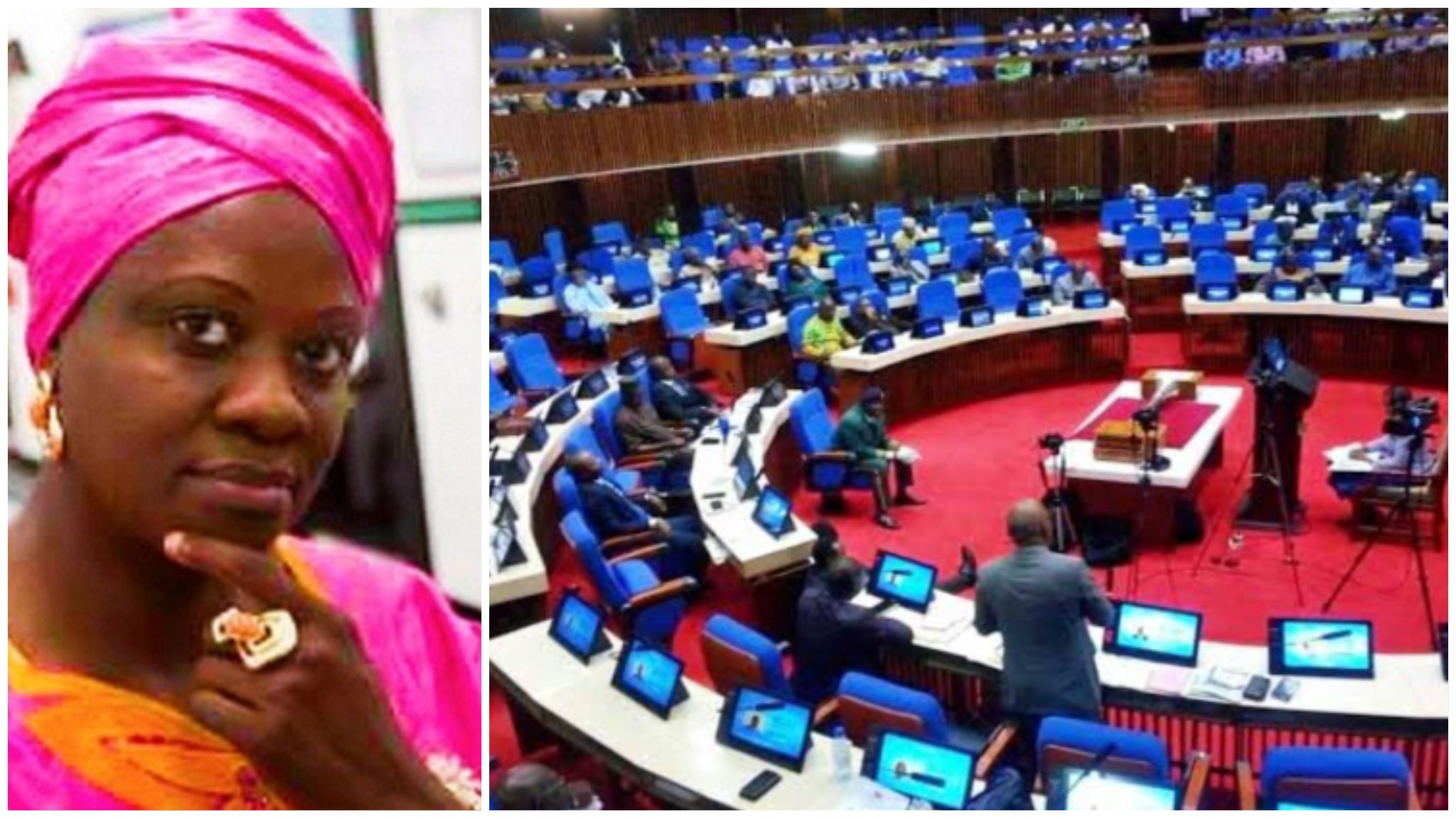

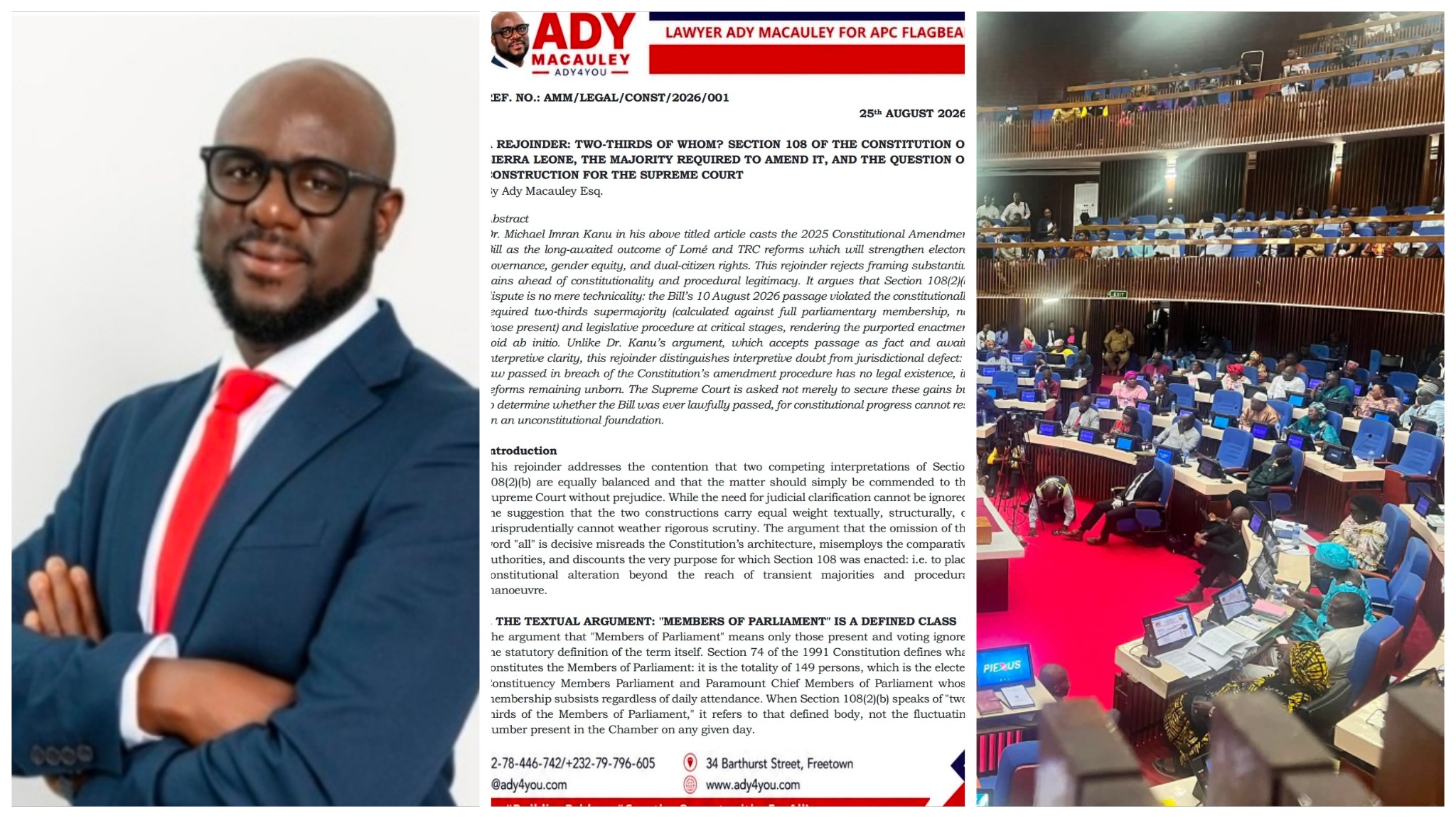
Lawyer and anti-corruption expert Ady Macauley Esq. has challenged the constitutional validity of the passage of Sierra Leone’s 2025 Constitutional Amendment Bill, arguing that the legislation failed to meet the two-thirds majority required under Section 108(2)(b) of the 1991 Constitution.
Macauley made the argument in a rejoinder to an article by Dr. Michael Imran Kanu, who described the proposed constitutional amendments as a significant outcome of reforms linked to the Lomé Agreement and the Truth and Reconciliation Commission (TRC), particularly in the areas of electoral governance, gender representation and the rights of dual citizens.
However, Macauley argued that the substantive objectives of the amendments cannot take precedence over constitutional and procedural compliance.
He maintained that the Bill’s passage on 10 August 2026 was unconstitutional because the required two-thirds majority should be calculated based on the full membership of Parliament rather than only Members present and voting.
According to him, the issue is not merely a technical disagreement over constitutional interpretation but a fundamental question of whether the Bill was lawfully passed in accordance with the Constitution.
Macauley cited Section 74 of the 1991 Constitution, arguing that “Members of Parliament” refers to the constitutionally defined membership of the House rather than the number of lawmakers present on a particular sitting day.
He further argued that the Constitution’s use of the phrase “two-thirds of the Members of Parliament” in Section 108(2)(b) should be understood as referring to the full membership of Parliament.
The lawyer said the absence of the word “all” from Section 108(2)(b) does not change its meaning, arguing that the Constitution already establishes Parliament as a defined body of Members.
He also referenced an earlier ruling by the Speaker of Parliament, Hon. Segepoh Thomas, in the matter involving former Auditor-General Lara Taylor-Pearce, which he said interpreted a two-thirds requirement as applying to the full membership of Parliament.
Macauley questioned why a different interpretation should now be applied to the constitutional amendment process, arguing that constitutional interpretation should not change based on political circumstances.
Another major issue raised by Macauley concerns the method used to establish the required majority.
He argued that a voice vote, in which the Speaker declares that the “ayes have it,” cannot establish whether the constitutionally required number of Members voted in favour of an amendment.
According to him, where the Constitution establishes a specific numerical threshold, Parliament must be able to demonstrate that the required number of votes was actually secured.
He therefore maintained that the absence of a recorded division or numerical vote meant there was no clear evidence that the two-thirds threshold had been satisfied.
Macauley also rejected the argument that parliamentary procedure or the Speaker’s ruling should shield the passage of the Bill from judicial scrutiny.
Citing the Privy Council decision in Bribery Commissioner v Ranasinghe [1965] AC 172, he argued that parliamentary certification cannot prevent the courts from determining whether constitutional requirements have been complied with.
He further relied on the supremacy of the Constitution under Section 171, arguing that neither Standing Orders nor a parliamentary ruling can override substantive constitutional requirements.
Macauley warned that interpreting the two-thirds requirement as applying only to Members present and voting could create an incentive for opposition lawmakers to withdraw from parliamentary proceedings in order to lower the number of votes required to amend the Constitution.
He argued that such an interpretation would undermine the purpose of a supermajority requirement, which is intended to ensure that constitutional changes receive broad and durable support.
He calculated that two-thirds of Parliament’s stated membership of 149 Members would require 100 affirmative votes, describing the threshold as a safeguard rather than an absolute minority veto.
While acknowledging that several proposed reforms in the Bill may have important national benefits, including measures aimed at strengthening the independence of electoral institutions, increasing women’s representation in governance and addressing the rights of dual citizens, Macauley maintained that the objectives cannot justify a process that allegedly violates the Constitution.
He urged the Supreme Court to determine not only how Section 108(2)(b) should be interpreted but also whether the Constitutional Amendment Bill was validly passed in the first place.
“The gains of a generation deserve to rest on a foundation that is not merely convenient, but constitutionally valid,” Macauley argued.
Macauley is a lawyer, anti-corruption expert, former prosecutor and former Commissioner of the Anti-Corruption Commission. He is also an alumnus of the International Law Enforcement Academy, with training at its Accra, Gaborone and Rosewall campuses, and is an aspirant for the APC flagbearership.