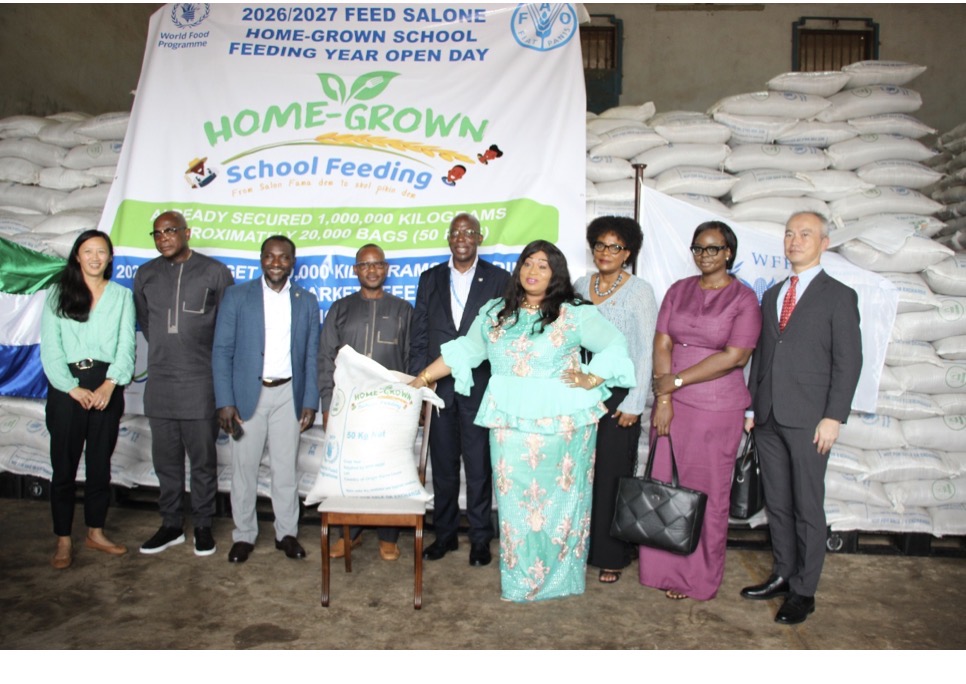

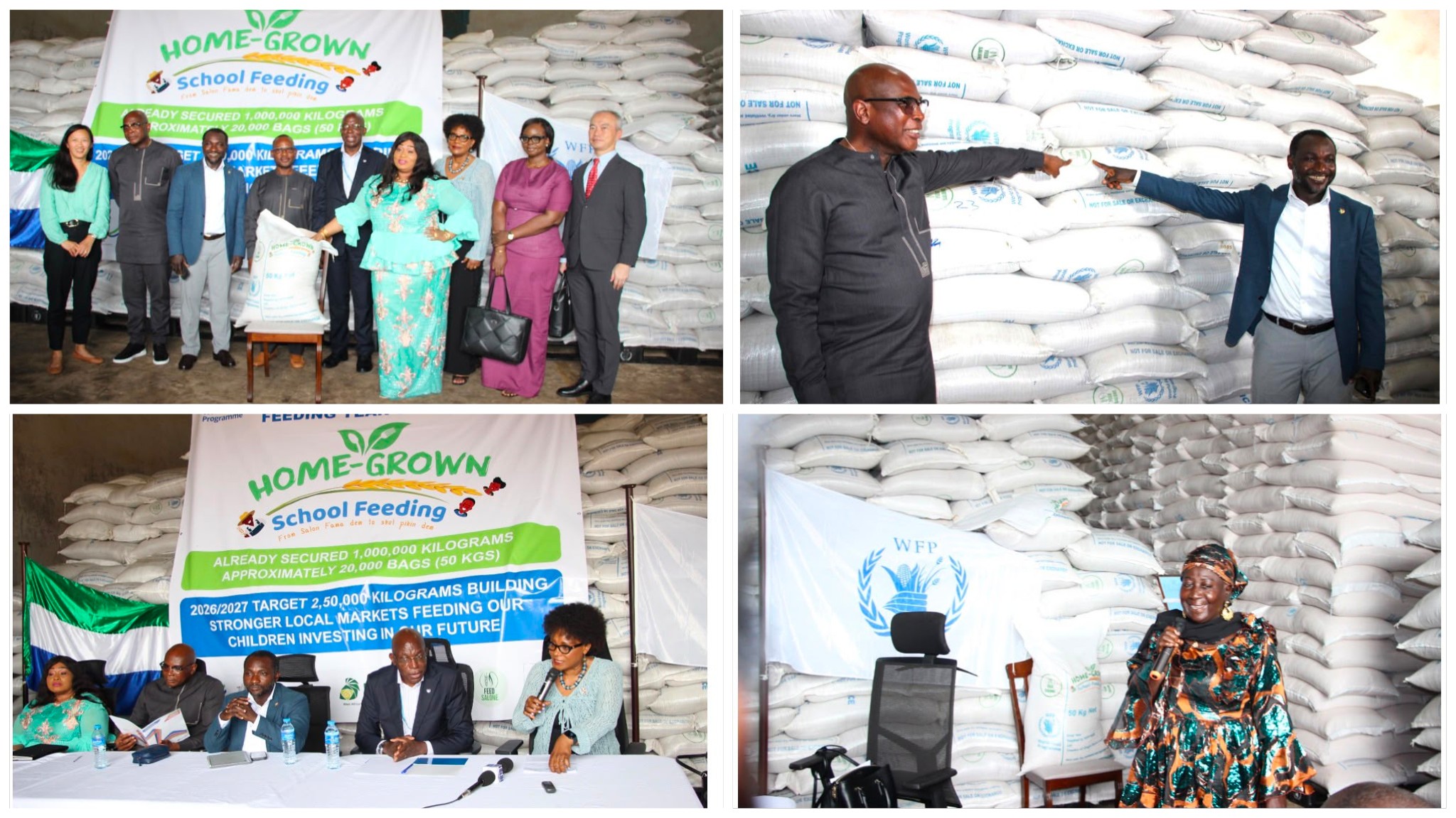
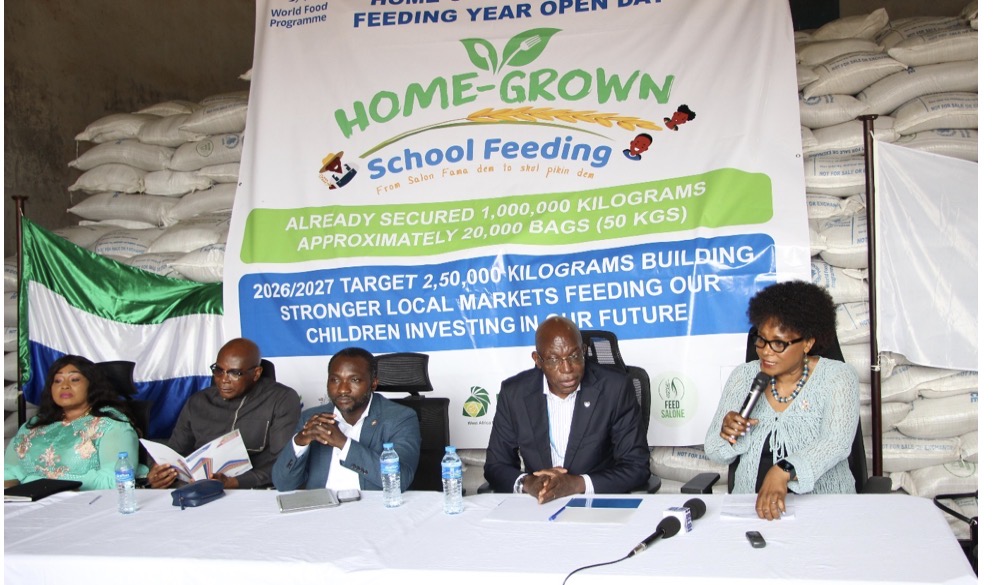
The United Nations World Food Programme (WFP), together with the Ministry of Agriculture and Food Security (MAFS), the Food and Agriculture Organization (FAO), and other partners, on 04 August 2026 launched the 2026/2027 Home-Grown School Feeding year at WFP’s Kissy Warehouse in Freetown, celebrating a significant achievement in local food procurement.
In 2026, WFP Sierra Leone has procured and collected more than 1 million kilograms of locally produced rice and pulses from smallholder farmers across the country. This quantity is equivalent to 21,158 bags of 50 kilograms each and represents an important milestone in WFP’s efforts to strengthen local food systems while supporting the national school feeding programme.
WFP Country Director, Andrew Odero underscored the transformative impact of the initiative on both farming communities and schoolchildren.
“The 2026/27 Home-Grown School Feeding Year is more than the opening of a school meals calendar; it is the opening of a national pathway that connects Sierra Leonean farmers to Sierra Leonean children, strengthens local food systems, keeps value within our communities, and invests in the health, learning and future of the next generation.”
Through these purchases, WFP has so far injected more than US$900,000 into the local economy, creating market opportunities for farmers and improving rural livelihoods. The food will be used to provide nutritious school meals to children while boosting demand for locally produced agricultural commodities.
Speaking at the launch, the Minister of Basic and Senior Secondary Education, Conrad Sackie, highlighted the significance of the programme.
“Every one of those bags purchased represents a farmer who chose to plant and harvest, and a child who will sit in a classroom with a full belly and a focused mind. Our ambition is to reach 2,500 metric tonnes this year.”
The achievement builds on strong results recorded in 2025, when WFP procured more than 1.95 million kilograms of food from local farmers, including over 1.9 million kilograms of rice and more than 50,000 kilograms of pulses. These purchases benefited approximately 22,500 farmers through smallholder farmer aggregators and injected nearly US$2 million into the rural economy in support of the Government’s Feed Salone Strategy.
United Nations Resident Coordinator Seraphine Wakana emphasized the broader development impact of Home-Grown School Feeding.
“The value of the UN is not simply in what each agency does individually, but in how we combine our expertise to support stronger and more sustainable national systems. Home-Grown School Feeding provides a practical platform for that collaboration.”
The programme continues to demonstrate the value of connecting smallholder farmers to reliable markets. By purchasing food locally, WFP is strengthening food security, improving education outcomes, and stimulating economic growth in farming communities.
Dr. Henry Musa Kpaka, Minister of Agriculture and Food Security, described the programme as a practical example of the Feed Salone vision in action.
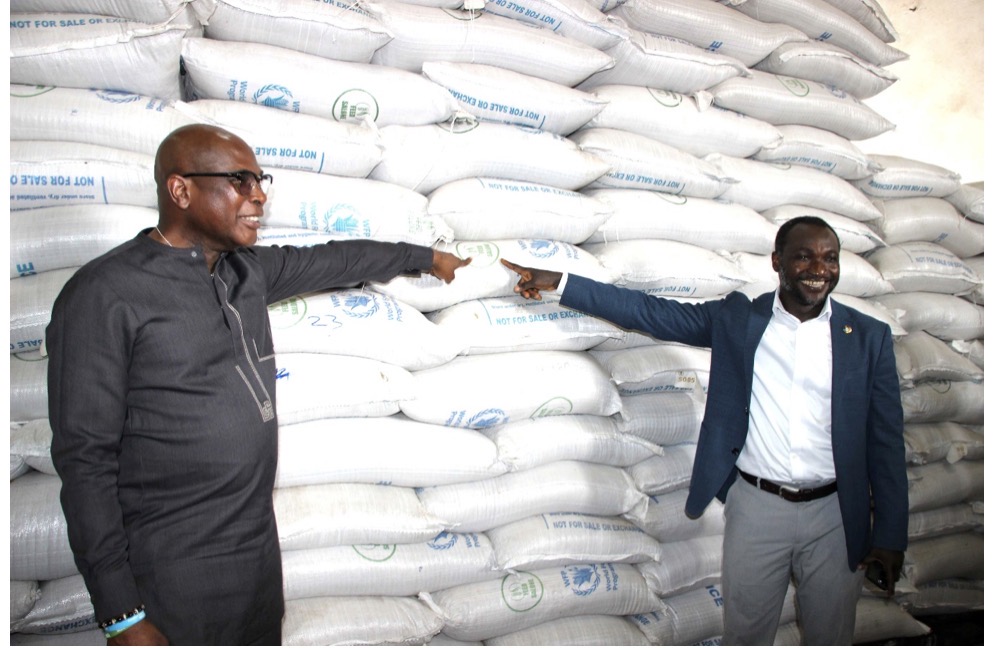
“WFP is the clearest example of what Feed Salone is and can be. It is about multisector partnership and supporting farmers to do what they do best, feed our people. Government has been providing the resources for WFP to link farmers to markets while supporting 250,000 children across five districts.”
For farmers, the programme provides both economic opportunities and confidence to invest in agricultural production. Isata Feika Sesay, Chairlady of the TakelenehFarmers Association in Kambia and a major aggregator of rice and pulses, noted that WFP’s support has transformed prospects for farming communities.
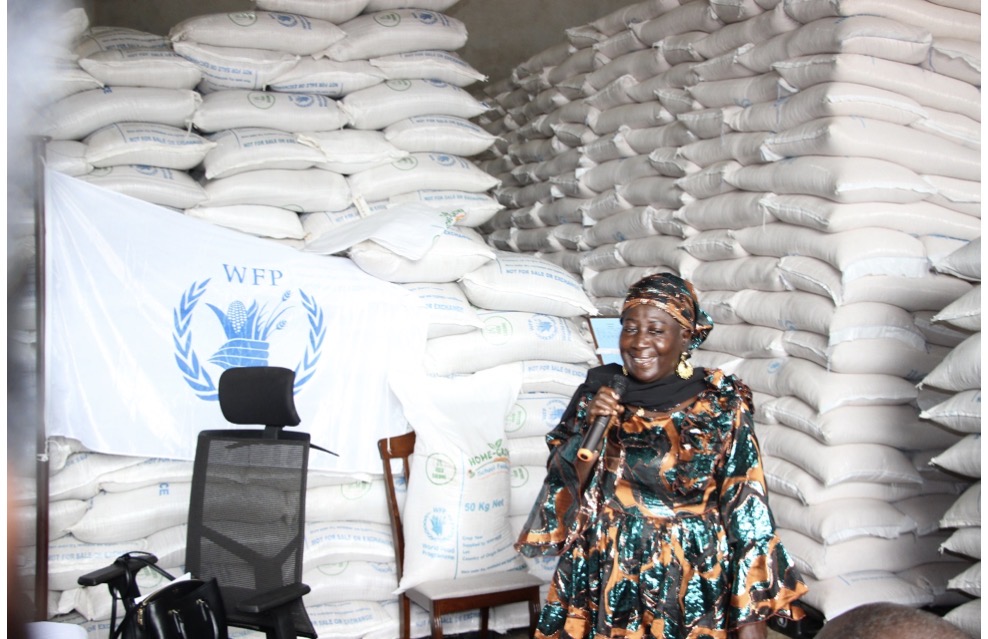
“The SATAKE milling machine and other support from WFP have given farmers in our community confidence to invest more in production because we know there is a market for what we grow. The income earned is helping families meet their needs, send children to school, and improve their livelihoods.”
She added that WFP’s school feeding programme has created reliable market opportunities for farmers and encouraged more women to engage in farming as a pathway to economic empowerment.
From the office of the Vice President, Minister of State Manty Tarawalli thanked WFP and its partners for their continued support to ensure that every child has access to safe, nutritious, and locally produced school meals.
“Today’s event is more than the opening of another school feeding cycle. It is a reaffirmation of our collective commitment to investing in our children, strengthening local food systems, and creating sustainable opportunities for Sierra Leonean farmers.”
She also used the occasion to announce the launch of Nourish Salone in December 2026, an initiative aimed at increasing demand for locally produced food, reducing malnutrition, and stimulating private sector investment in agriculture.
As Sierra Leone advances its home-grown school feeding agenda, local procurement remains a powerful tool for enhancing resilience, improving nutrition, supporting education, and strengthening rural economies. Every bag of rice and pulses purchased contributes to a positive cycle of benefits for farmers, communities, and schoolchildren.
In addition to the financial contribution of the Government of Sierra Leone, home-grown school feeding is also funded by the Government of the Federal Republic of Germany, Iceland and Japan.
Together, WFP and its partners are feeding children, supporting farmers, and building stronger, more resilient local food systems in Sierra Leone.