
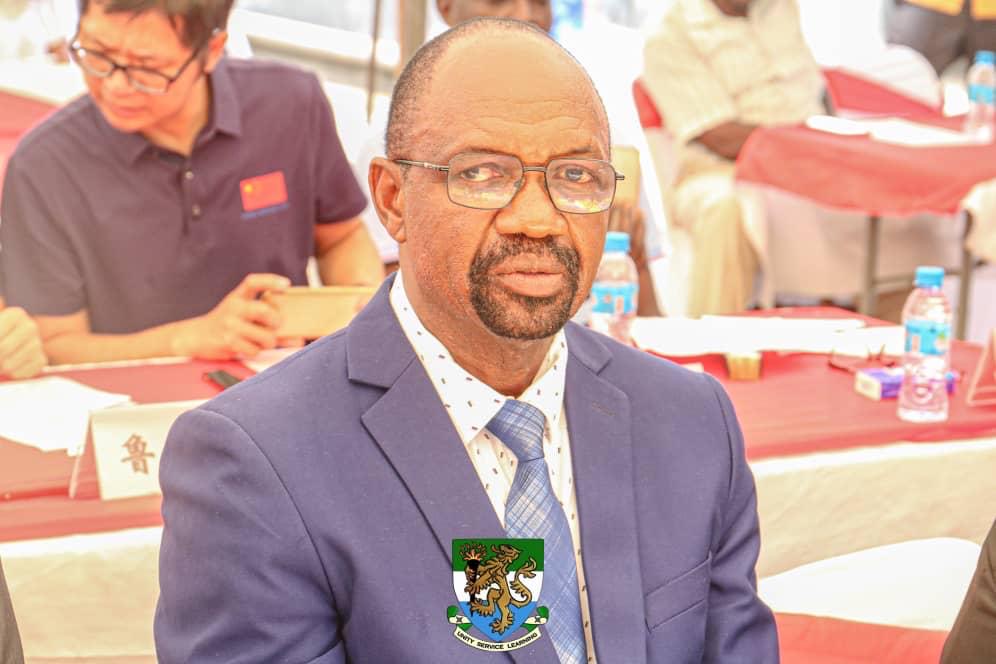
The Vice Chancellor and Principal of the University of Sierra Leone, Professor Aiah Lebbie, has expressed concern over what he describes as a steady decline in students’ interest in mathematics and the sciences, warning that the trend could have long-term consequences for national development.
Speaking on the issue, Professor Lebbie questioned why students who perform strongly in mathematics at the secondary school level are increasingly opting out of science-related degree programmes at the university. He cited cases where students obtain excellent grades, such as an A1 in Mathematics and a B2 in Further Mathematics, yet choose to pursue disciplines outside the sciences.
He recalled an encounter with a student at Fourah Bay College (FBC) who told him she had scored an A1 in Mathematics. When asked why she had not applied to study Mathematics at the university, the student reportedly responded in Krio: “Ar nor know aw ar get A1 pa Maths sef” (I don’t even know how I got an A1 in Mathematics).
Professor Lebbie noted that students with such academic profiles would normally be well positioned to pursue Mathematics, Engineering, and other science-related fields. However, many are instead applying for courses in the social sciences and other non-science disciplines.
According to him, this pattern reflects a worrying mismatch between students’ academic strengths and their chosen fields of study.
Within the University of Sierra Leone system, he said, the trend is contributing to gaps in critical sectors that rely heavily on scientific and technical expertise.
Professor Lebbie stressed that Sierra Leone needs more students to pursue Science, Technology, Engineering, and Mathematics (STEM) pathways if the country is to strengthen innovation and address its development challenges. He argued that negative attitudes toward Mathematics and related subjects may be limiting the pool of future professionals needed in key industries.
Education stakeholders have long pointed to factors such as examination malpractice, leakages in the WASSCE examinations, and inadequate mentorship as possible contributors to the problem.
He called for stronger career guidance at the secondary school level, improved support for Mathematics and science education, and targeted encouragement for high-performing Mathematics students to pursue science-based university programmes.