
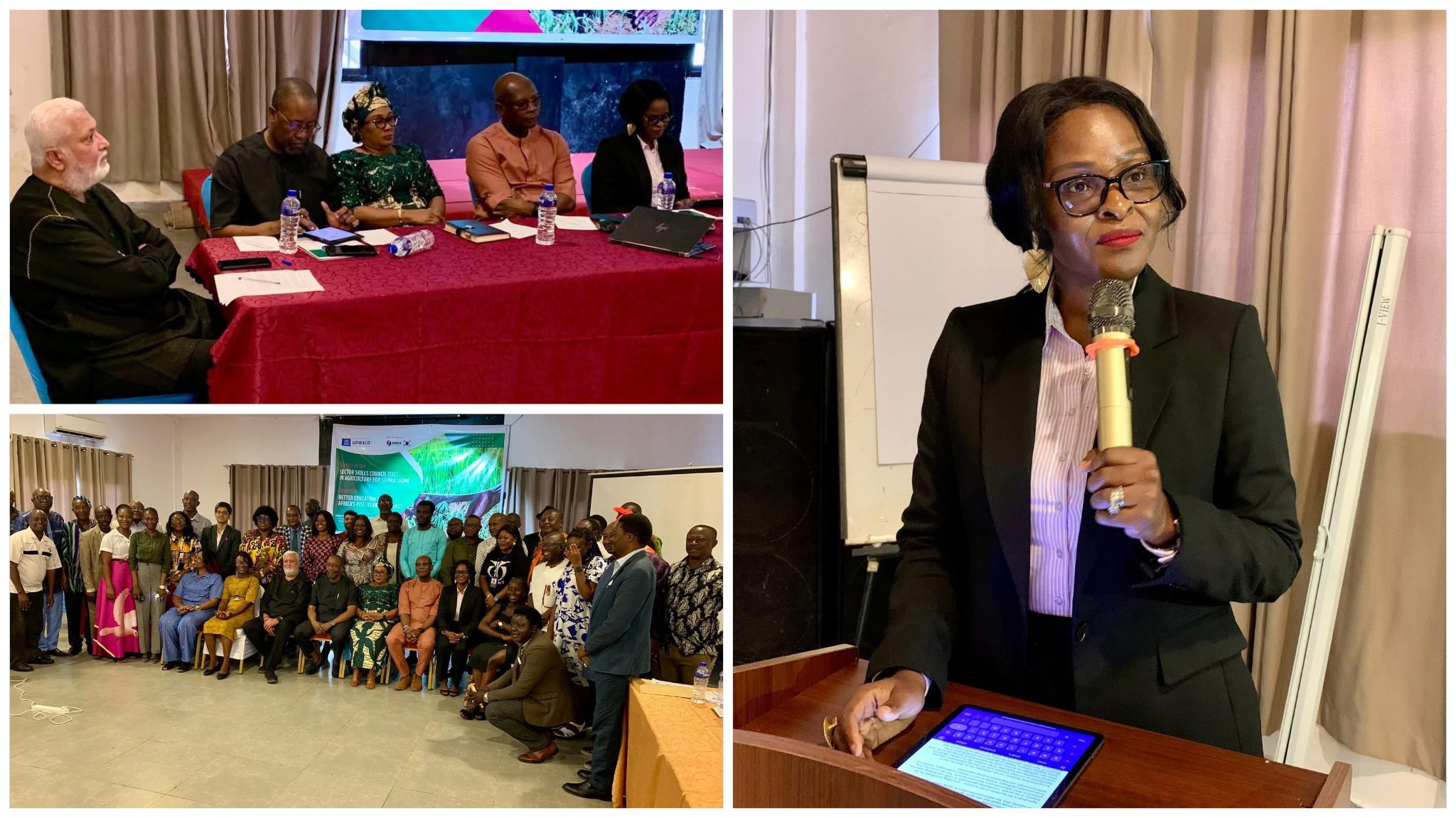
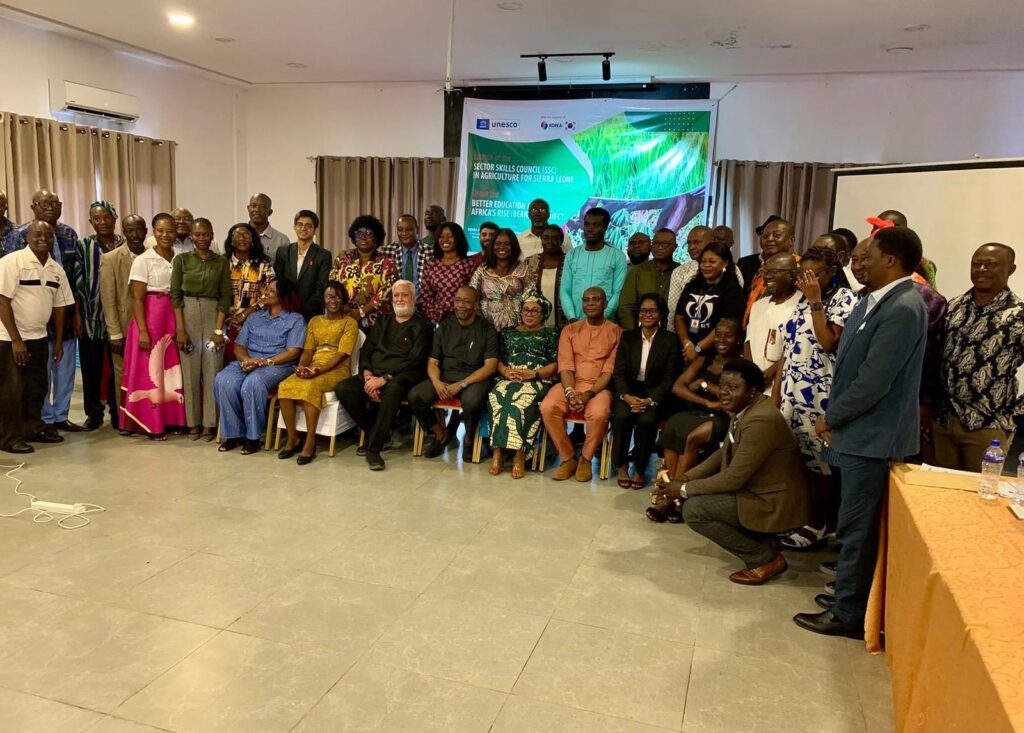
The Ministry of Technical and Higher Education (MTHE), in partnership with UNESCO, has inaugurated the Sector Skills Council for Agriculture (SSC4A) under the Better Education for Africa’s Rise III (BEAR III) Project, at Sierra Palms, Freetown.
The SSC4A is dedicated to strengthening the relevance and responsiveness of agricultural Technical and Vocational Education and Training (TVET). Supported by UNESCO’s BEAR III project, the council focuses on developing standardized occupational standards, conducting skills forecasts, and fostering greater private sector participation in training and curriculum development.
This initiative aims to align training programs with labor market needs, ultimately boosting productivity and driving economic growth within the agricultural sector.

In his welcome address, MTHE’s Chief Technical and Higher Education Officer, Dr. Josephus Brimah, described the event as historic for education in Sierra Leone. He recalled the creation of MTHE in 2018 to strengthen technical education, stressing that while education is seen as the key, TVET is the “master key” to economic growth. With 5.4 million hectares of arable land, he said agriculture must drive development, and the new Council would guide curricula, quality delivery, and a knowledge-based system.
Deputy Minister of Agriculture and Food Security, Theresa Tenneh Dick, called the launch timely, noting agriculture contributes over half of GDP but struggles with low productivity and import dependence. She said the Council would align training with modern farming, mechanisation, and digital tools, helping reduce rice imports and move farmers toward commercial production. She emphasized that government alone cannot transform the sector, urging collective action.
Minister of Employment, Labor, and Social Security, Mohamed Rahman Swaray, hailed the Council as vital for harnessing agriculture through skills development. He linked it to the national development plan and Feed Salone strategy for food self-sufficiency by 2030. He highlighted trade testing, training in mechanisation and post-harvest handling, and an occupational safety manual for agriculture Small and Medium-sized Enterprises (SMEs) to boost productivity and workers’ safety.
Minister of Basic and Senior Secondary Education, Conrad Sackey, said the Council was a historic milestone under President Bio’s Big Five priorities. It would align training with industry, empower farmers, and build a skilled workforce to drive productivity, revenue, and prosperity.
Oladapo Coulson-Olowu, Public Relations Officer and Communications Expert of the National Council for Technical and Vocational Education (NCTVE), said the SSC4A is the first of its kind in Sierra Leone, modeled on the UK’s skills councils. He noted its role in curriculum design, occupational standards, and supporting Feed Salone through productivity, jobs, and food sovereignty. Despite funding challenges, he stressed partnerships could close the skills gap and make Sierra Leone’s workforce competitive.
Mahesh Nandwani, SSC4A Chairman, called the Council a foundation for agriculture’s future, stressing vast untapped potential- only 15% of arable land is cultivated. With opportunities for youth and women, he said skills development is key to reducing imports, creating jobs, and ensuring food security. He urged strong private sector collaboration to shape TVET to industry needs.
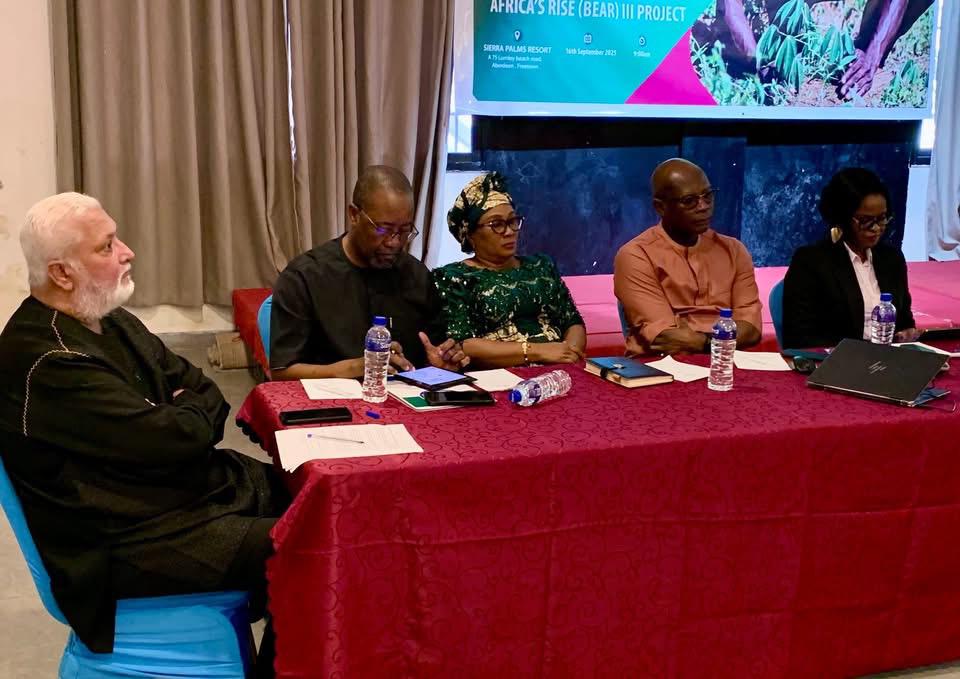
In her keynote address, Dr. Haja Ramatulai Wurie, Minister of Technical and Higher Education, described the launch as proof of collaboration among ministries, partners, and industry. She acknowledged challenges in agriculture but said the Council would drive a coordinated, market-driven, and future-ready skills system, complementing Feed Salone. She highlighted private sector involvement, praised Chairman Nandwani’s leadership, and stressed that every graduate should be job-ready and innovative. She credited the UNESCO-Korea BEAR III Project for supporting Sierra Leone’s TVET reforms and aligning education with labour market needs.