
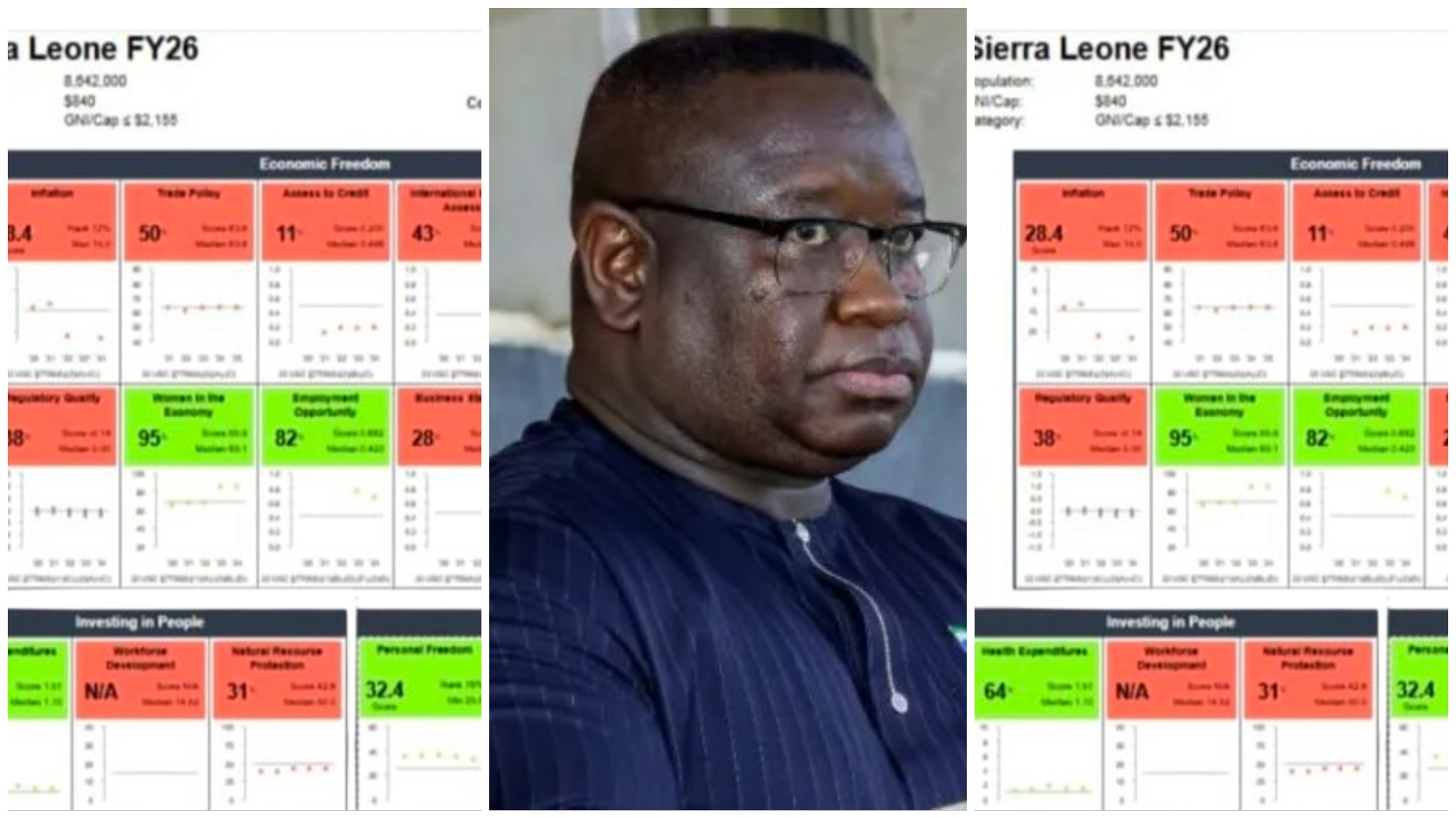
Sierra Leone has once again suffered a humiliating setback in international governance rankings, failing 13 out of 22 indicators in the Millennium Challenge Corporation (MCC) Fiscal Year 2026 Scorecard.
The country managed to pass only nine, exposing deep-seated weaknesses in economic management, democratic governance, and personal freedoms.
The MCC assessment, which evaluates countries across four key pillars Economic Freedom, Investing in People, Ruling Justly, and Personal Freedom reveals that Sierra Leone remains stuck at the lower end of global performance metrics, with particularly alarming scores in the economic and civil liberties categories.
Economic Freedom: The Worst-Performing Sector
The economic indicators painted the bleakest picture. Inflation soared to 28.4%, placing Sierra Leone in the 0th percentile globally—a red flag signaling a fragile macroeconomic environment. Fiscal policy scored –4.3 (11th percentile), trade policy ranked 58.0 (11th percentile), and regulatory quality fell to –0.64, all underscoring weak fiscal discipline and poor business competitiveness.
Access to credit (30th percentile) and land rights (50th percentile) also scored poorly, reflecting ongoing structural barriers to private sector growth and limited investor confidence.
Investing in People: Modest Gains Amid Fiscal Strain
Despite the grim economic picture, there were faint signs of progress in the Investing in People category. Sierra Leone’s health expenditure rose to 6.3% of GDP (64th percentile), while girls’ primary school completion (94.1%) and immunization coverage (91%) both stood at the 71st percentile.
These achievements highlight the government’s continuing investments in health and education, even as fiscal constraints persist.
Ruling Justly: Fragile Institutions, Limited Accountability
Under the Ruling Justly pillar, Sierra Leone passed the Control of Corruption and Accountability indicators, signaling moderate progress in governance reforms. However, serious institutional weaknesses remain.
Government Effectiveness and Rule of Law both scored –0.6 (21st percentile), while Political Rights (32) and Civil Liberties (33) hovered around the 30th percentile. These figures suggest fragile institutions and limited democratic consolidation despite anti-corruption efforts.
Personal Freedom: A Category Completely Failed
Perhaps the most shameful outcome lies in the Personal Freedom category, where Sierra Leone failed entirely. While Freedom of Religion scored a respectable 60 (60th percentile), scores for Freedom of Assembly, Speech, and Internet Access (33rd percentile each) reveal a troubling decline in civic space and digital rights.
These figures raise urgent questions about the government’s respect for freedom of expression and citizens’ ability to participate freely in democratic processes.
Overall Assessment: A Sobering Reality Check
With a population of 8.6 million and a Gross National Income per capita of $840, Sierra Leone remains classified as a low-income country (≤ $2,155). The FY2026 MCC scorecard offers a sobering reminder of the country’s governance and development challenges.
While Sierra Leone passed nine indicators—most notably in health, education, and anti-corruption—it failed 13, with economic freedom emerging as the weakest link.
As the nation enters a new development cycle, the MCC results serve as both a warning and a call to action, demanding urgent reforms in governance, economic policy, and human rights protection. Failure to act decisively risks further reputational damage and the loss of vital international development support.