
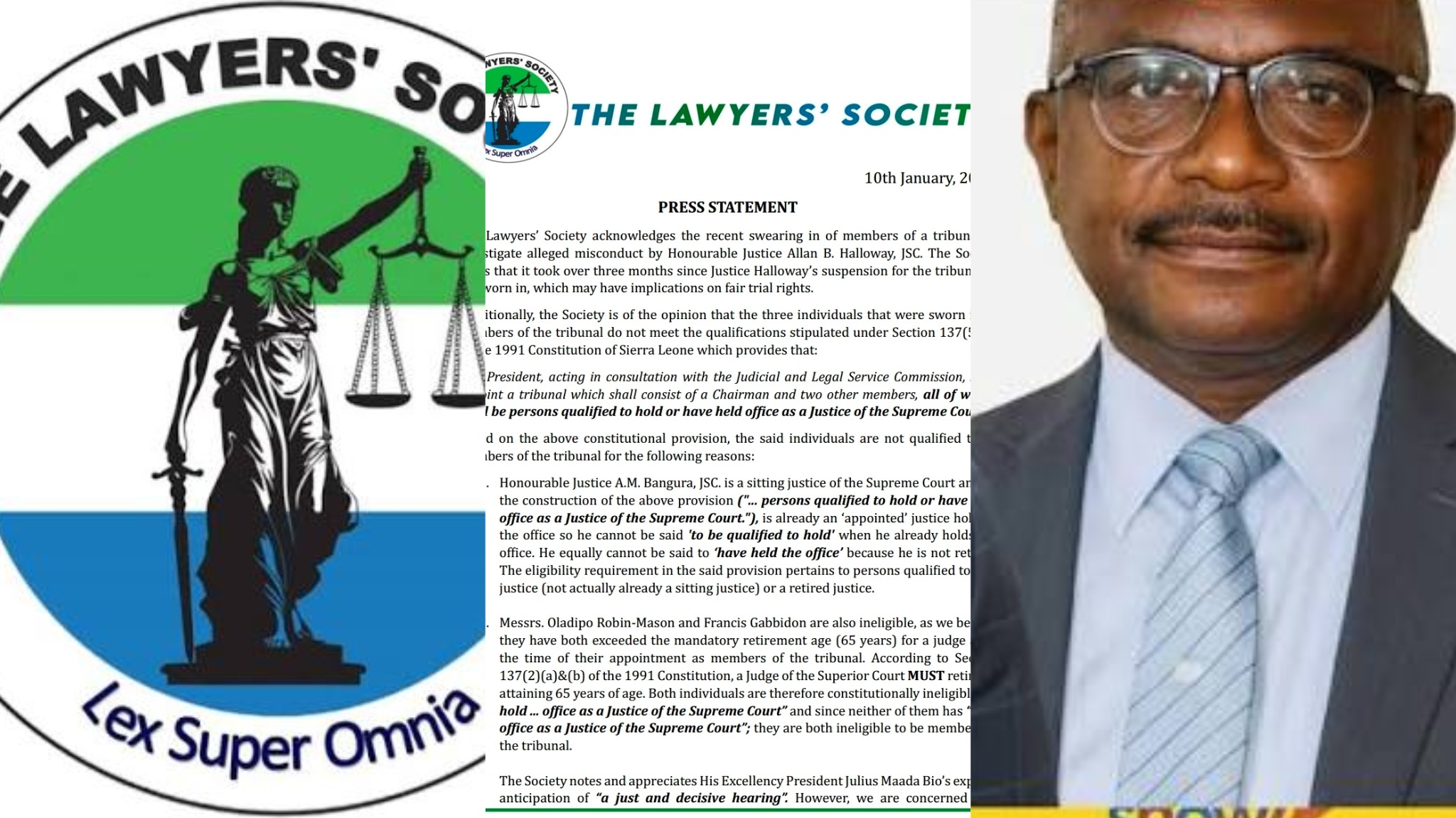
The Lawyers’ Society has raised serious constitutional concerns over the recently sworn-in tribunal established to investigate alleged misconduct by Honourable Justice Allan B. Halloway, JSC, cautioning that the composition of the panel may undermine due process and the rule of law.
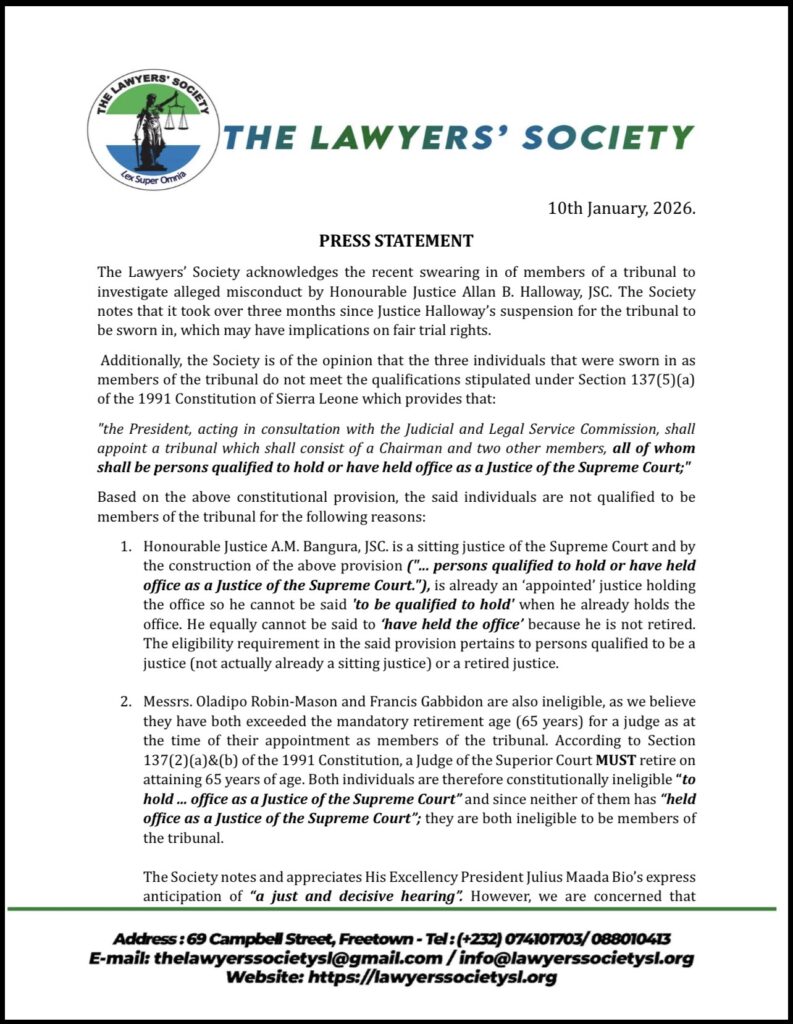
In a press statement issued on Friday, the Society acknowledged the swearing-in of the tribunal members but noted that it took over three months after Justice Halloway’s suspension for the tribunal to be constituted. According to the Society, this delay could have implications for the fair trial rights of the suspended judge.
Beyond concerns about timing, the Lawyers’ Society questioned the constitutional eligibility of the three individuals appointed to serve on the tribunal. The Society referenced Section 137(5)(a) of the 1991 Constitution of Sierra Leone, which provides that a tribunal appointed by the President, in consultation with the Judicial and Legal Service Commission, must consist of a chairman and two other members who are “persons qualified to hold or have held office as a Justice of the Supreme Court.”
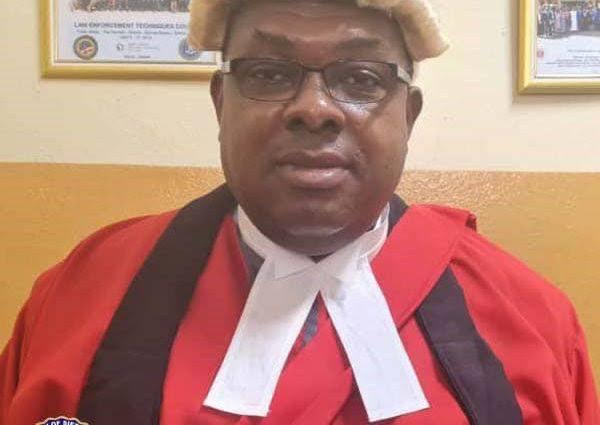
The Society argued that Honourable Justice Abdulai Masiyambay Bangura, JSC, who was appointed as Chairman of the tribunal, does not meet the constitutional requirement. It explained that Justice Bangura is a sitting Justice of the Supreme Court, and therefore cannot be said to be “qualified to hold” the office, as he already holds it, nor can he be said to have “held” the office, since he is not retired. The Society maintained that the constitutional provision applies to persons qualified for appointment as justices or those who have previously held the office, not serving justices.
The Lawyers’ Society also challenged the eligibility of Mr. Oladipo Robin-Mason and Mr. Francis Gabbidon, who were appointed as members of the tribunal. It stated that both individuals are believed to have exceeded the mandatory retirement age of 65 years for judges at the time of their appointment.
Citing Section 137(2)(a) and (b) of the 1991 Constitution, the Society noted that a judge of the Superior Court of Judicature must retire upon attaining the age of 65. As neither Mr. Robin-Mason nor Mr. Gabbidon has previously held office as a Justice of the Supreme Court, and are allegedly above the retirement age, the Society argued that they are constitutionally ineligible to serve on the tribunal.
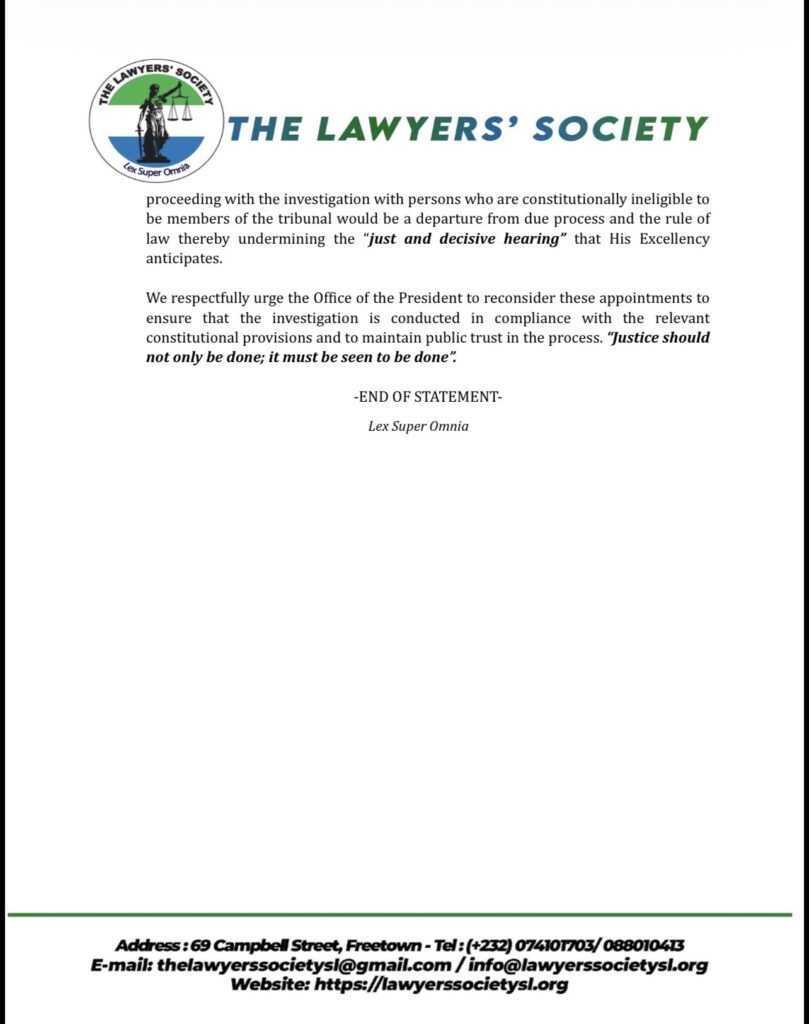
While acknowledging President Julius Maada Bio’s expressed desire for “a just and decisive hearing,” the Lawyers’ Society warned that proceeding with a tribunal whose members are constitutionally ineligible would amount to a departure from due process and could undermine public confidence in the investigation.
The Society therefore called on the Office of the President to reconsider the appointments in order to ensure compliance with constitutional provisions and to safeguard the integrity of the process.
“Justice should not only be done; it must be seen to be done,” the statement concluded, stressing the importance of public trust in matters involving judicial accountability and constitutional governance.