
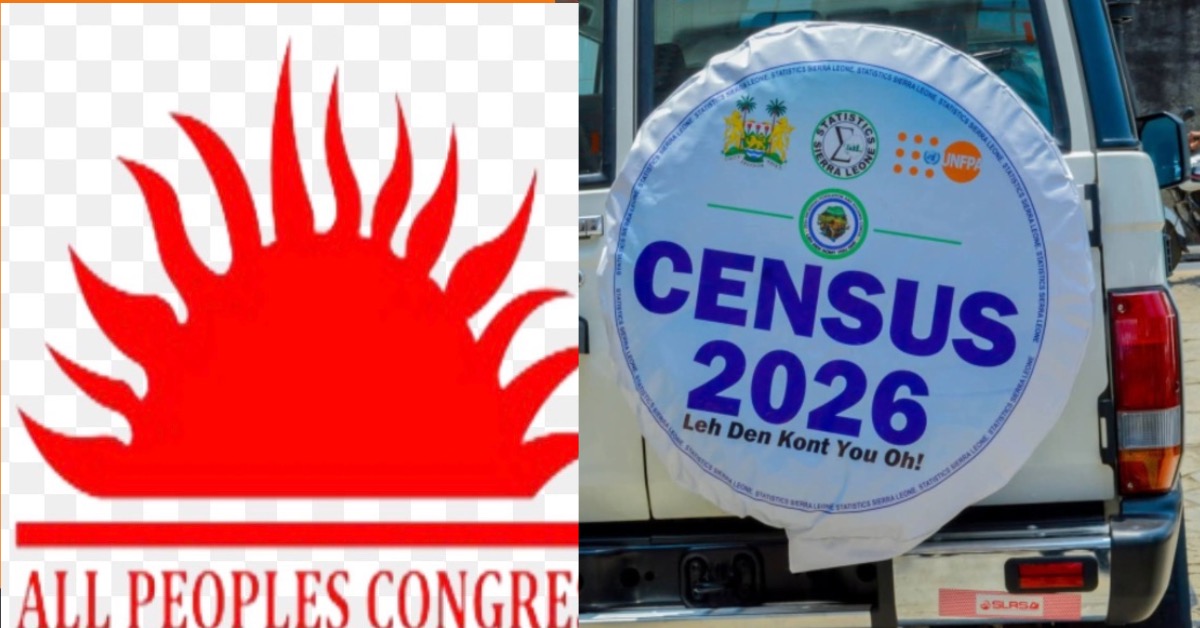
Sierra Leone’s main opposition All Peoples Congress (APC) has raised concerns over the operational, technical and administrative preparedness of Statistics Sierra Leone (Stats SL) ahead of the country’s first fully digital Population and Housing Census, scheduled to begin on December 1, 2026.
In a press statement issued on Tuesday, 25 November 2026, the APC said its nationwide monitoring teams, working under the party’s Census Technical Committee, had identified several outstanding issues that could affect the credibility, efficiency and quality of the census.
The party disclosed that the concerns were scheduled to be discussed at a technical meeting with the Statistician General on November 18. However, it said Stats SL cancelled the meeting on the day it was scheduled to take place, as the APC technical team was preparing to attend.
The APC maintained that its concerns were not intended to disrupt the census but to ensure that every resident is counted, enumerators are adequately equipped and the final census figures can withstand independent technical scrutiny.
Tablet Shortages and Operational Preparedness
One of the major concerns raised by the opposition party relates to shortages of tablets and other logistical challenges encountered during the census training exercise.
The APC acknowledged that Stats SL, in its November 20 update, admitted to challenges involving tablet distribution, defective devices, overcrowded training venues, inadequate catering and logistics, last-minute changes to training locations and reduced practical training time.
However, the party argued that these challenges reflected wider weaknesses in operational preparedness, logistics coordination and contingency planning.
It questioned the total number of tablets required nationwide, how many were procured, how many were functional before and after the training exercise, and the outstanding shortages in each district.
The APC called on Stats SL to publish a district-by-district tablet reconciliation statement, arguing that public confidence in the census requires verifiable information rather than general assurances.
Concerns Over Bring Your Own Device Arrangement
The party also questioned Stats SL’s reliance on the Bring Your Own Device (BYOD) arrangement, which allows trainees to use their personal devices during training.
While acknowledging that Stats SL described the approach as an internationally accepted practice, the APC cited the United Nations Principles and Recommendations for Population and Housing Censuses, Revision 4, which emphasise standardised equipment, effective device management and information security.
The opposition party argued that trainees assessed using personal smartphones should not automatically be considered competent to operate the official census tablets.
It therefore recommended supervised practical training on official census equipment for all trainees who relied on personal devices, followed by fresh competency assessments using the actual devices they would operate in the field.
It also called on Stats SL to make its device-testing and compatibility documentation publicly available.
The APC stressed that BYOD could serve as a contingency arrangement but should not replace standardised equipment, adequate practical training and demonstrated operational competence.
Oversized Enumeration Areas Raise Data Quality Concerns
The APC identified the size of Enumeration Areas (EAs) as one of its most significant concerns, warning that oversized areas could affect the accuracy and quality of the census.
Referring to Sierra Leone’s Cartographic Manual 2025, the party said the recommended planning thresholds are between 400 and 600 people, or 80 to 120 households, for urban enumeration areas, and 350 to 500 people, or 60 to 100 households, for rural areas.
It noted that Stats SL’s November 20 update referred to approximately 700 enumeration areas exceeding the applicable planning thresholds.
However, the APC said figures contained in the National Mapping Report published in September 2026 presented a different picture, identifying 2,840 enumeration areas, representing 12.6 per cent, as having populations exceeding 600 people.
The party further cited 70 additional enumeration areas with populations above 700 people and disclosed that, in Western Area Urban alone, 761 of the 2,335 enumeration areas, representing 32.6 per cent, exceeded the 600-person threshold.
According to the APC, the figures indicate that 2,910 enumeration areas exceed 600 people, more than four times the figure referenced in Stats SL’s update.
It called for a formal technical reconciliation of the figures and the publication of a district-by-district register identifying all enumeration areas exceeding the recommended thresholds.
The party also referenced paragraph 3.102(f) of the United Nations Principles and Recommendations for Population and Housing Censuses, Revision 4 (2025), which states that enumeration areas should be sufficiently accessible for a single enumerator to cover within the enumeration period.
Questions Over Deployment and Training Allowances
The APC also raised concerns about the deployment of census personnel outside their districts or chiefdoms of origin.
It called on Stats SL to publish a clear deployment policy outlining the criteria for assigning enumerators, possible exceptions and safeguards, while prioritising qualified personnel for deployment within their areas of origin wherever practicable.
The party further questioned delays in the payment of training allowances, claiming that its monitoring teams continued to receive reports of trainees who had not received their entitlements despite the communicated mobile money payment arrangement.
It urged Stats SL to settle all outstanding allowances before deployment, stressing that census personnel should not be expected to carry out their responsibilities while their legitimate entitlements remain uncertain.
APC Proposes Seven-Point Corrective Framework
To address the concerns before enumeration begins, the APC proposed a seven-point corrective framework.
The recommendations include reconvening technical discussions with the Statistician General and census management within 72 hours, and publishing three operational registers before Census Night covering tablet accountability, oversized enumeration areas and field personnel deployment.
The party also called for additional supervised practical training and repeat competency assessments for trainees who used personal devices, the settlement of all outstanding training allowances and transparent payment schedules.
Other recommendations include prioritising the deployment of qualified personnel within their districts and chiefdoms of origin, establishing a National Census Situation Room and district response centres with hotlines and real-time reporting mechanisms, and inviting independent technical experts, with support from UNFPA, to review census preparedness before enumeration begins.
APC Appeals to International Partners
The opposition party has also brought its concerns to the attention of UNFPA, the United Nations Statistics Division, development partners, diplomatic missions, Parliament, civil society organisations and the media.
It urged international partners to ensure that their support for the census extends beyond the provision of equipment and funding to include transparency, methodological integrity and public confidence in the exercise.
The APC clarified that it was not calling for the postponement or disruption of the census but was seeking urgent, evidence-based corrective measures to protect the significant national and international investment already made.
Census to Begin December 1
According to the statement, Census Night is scheduled for December 1, 2026, with the enumeration exercise expected to conclude on December 16, 2026.
The APC encouraged residents to participate fully in the exercise and urged everyone to ensure that they and their households are counted.
It described the census as a critical source of statistical information for national development planning, resource allocation and the delivery of public services over the coming decade.
The party concluded by calling for an inclusive exercise in which no community, household or individual is left out, emphasising that every person, household and community matters in determining the country’s population and development needs.
The statement was issued by the National Secretariat of the All Peoples Congress in Freetown.