

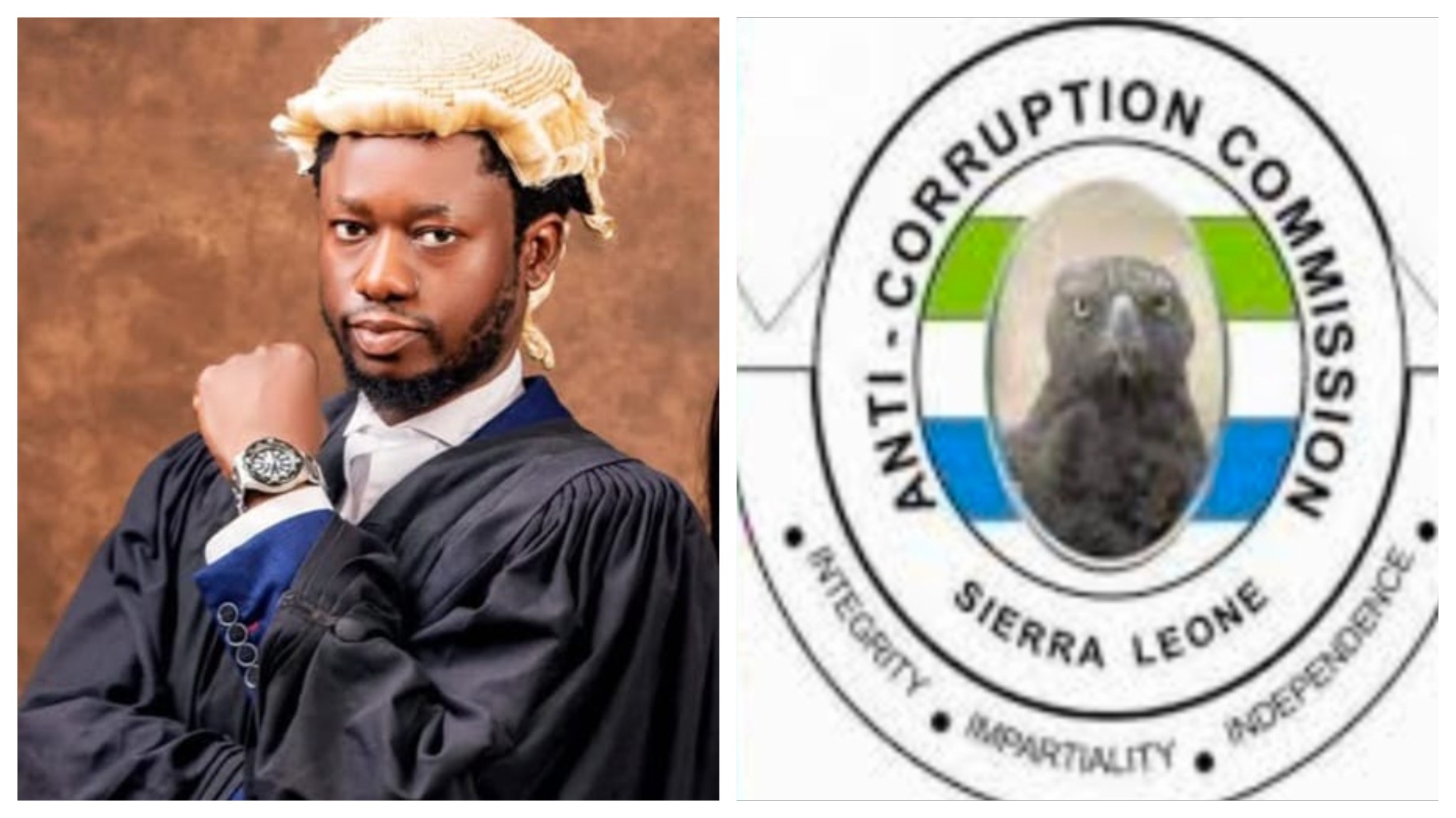
By: Joel Tejan Deen-Tarawally Esq.
Prosecutor, ACC
LL.M, BL, LL.B, B.A
One of the realities to contend with in the fight against corruption is the ability of corruption to fight back in the face of an existential threat. This does not mean that the phenomenon of corruption itself possesses the ability to repel the hunters of corruption; rather, it means that the social architecture, cultural orientation, and the beneficiaries of corruption will certainly resist any serious attempt to sanitize a corrupt society. Hence, the beneficiaries of corruption will fight back in order to protect themselves and maintain the status quo.
It is, in fact, often the case that those who engage in corruption have the influence, economic means, and wherewithal to navigate their way in escaping conviction, punishment, or the full force of the law, and the presumption of innocence is their greatest ally. What is, however, completely unacceptable is the intimidation of whistleblowers and interference with investigation and prosecution witnesses, which often seriously impedes the effectiveness of the fight against corruption. This is a perennial problem not just in Sierra Leone but also in most developing countries where corruption is both systemic and cultural.
Whistleblowers are individuals who report wrongdoing within institutions, often at great personal risk. They are crucial in unveiling corrupt practices that would otherwise remain hidden, especially within government ministries, departments, and agencies. A witness, on the other hand, is an individual who is called to testify in court. In the battle against corruption, effective enforcement relies not only on strong laws but also on the courage of individuals who are willing to blow the whistle on corruption by speaking out.
Historically, the fear of retaliation and lack of adequate protection have discouraged whistleblowers and witnesses from coming forward in fighting corruption in Sierra Leone. As a Prosecutor, I have handled an anti-corruption case where a defendant and his defence counsel attempted using intimidation tactics in order to prevent a key prosecution witness from testifying in court; and in order to protect the said witness I had to invoke Section 82(1) of the Anti-Corruption Act of 2008, which provides that a person who discloses to the Commission an act of corruption by a public officer or public body shall incur no criminal or civil liability. I proceeded with the case to its completion, and the defendant was found guilty.
Besides Section 82 of the Anti-Corruption Act of 2008, there is also Section 81 that protects the identity of an informer and Section 83 that makes provision for a Judge to order appropriate measures for the protection and safety of a witness, including ordering that proceedings be held in camera and not in open court.
However, as commendable as the aforesaid provisions may be, they are intrinsically inadequate for the purpose of providing a well-structured and efficient whistleblower and witness protection legal framework. For instance, the aforesaid provisions do not address quite a number of issues including the types of protection measures and how to determine the type of protection measure to adopt in a given case, the manner of concealment of identity and the issuance of new personal documents, consent for entering into legal obligation, interrogation and investigation of a protected person, restoration of original identity, and a proper reward system, to name a few.
Hence, pursuant to Section 140 of the Anti-Corruption Act, 2008 (as amended in 2019), the Commission has, by statutory instrument, promulgated the Whistleblower and Witness Protection Regulations, marking a significant shift toward empowering citizens in the fight against corruption, ending corruption impunity, curbing intimidation, and strengthening accountability.
The Whistleblower and Witness Protection Regulations introduce a new, pragmatic, and contextual legal framework that clinically addresses some of the historical and cultural problems associated with ‘conventional protectionism’ in the fight against corruption. It is by virtue of this mindset of conventional protectionism that a particular group or class of people will protect the ‘thieves of state resources’ simply because they are considered as being part of the same group or class; hence such thieves are considered their own thieves and therefore they do everything possible to protect them.
This is why whistleblowers occupy an important but risky position, as the possibility of intimidation, discrimination, and harm against them is always high. Recognizing that this is not just a threat to whistleblowers but also to the fight against corruption, and in the exercise of the powers conferred on it by Section 140 of the Anti-Corruption Act of 2008 (as amended in 2019), the Anti-Corruption Commission, through Statutory Instrument No. 83 of 2025, promulgated the Whistleblower and Witness Protection Regulations as a game changer in safeguarding these individuals and further bolstering the fight against corruption.
Here is how the Whistleblower and Witness Protection Regulations of 2025 have recalibrated the fight against corruption in Sierra Leone by establishing a robust and enforceable protection regime:
The Regulations, in their interpretation provision, make a significant determination of the fact that whistleblowers are sometimes subject to disadvantage, harm, or detriment and therefore create an opportunity for them to seek protection from the Commission. The term “detriment” is defined in the Regulations as “anything done or omitted to be done that causes disadvantage, loss or harm to a whistleblower, his relative or interest.” Section 3(1) provides that “…where a whistleblower or a witness has reasonable belief that, due to his disclosure of an information regarding the commission of a corruption offence, he is very likely to suffer harm or danger, he may apply for his protection to the Commission.”
The Commission, on receipt of a request for protection and within 14 days, will then assess the situation and determine whether the circumstances warrant protection of the whistleblower or witness. Where the Commission decides that protection is needed, it shall immediately, and not later than 7 days, enter into a protection agreement with the whistleblower or witness as the case may be.
By virtue of the said protection agreement, the Commission will have a duty to uphold the right and freedom of the protected person to the extent that is deemed essential for his protection; notify the protected person in advance to refrain from any activity that may impede the protection measure; inform the protected person of the basic needs to be provided to him; ensure that the protected person gets necessary counseling services while under protection; cover relocation costs where the protection measure entails relocation of the protected person; and take all necessary steps to ensure the effectiveness of the protection measures under the protection agreement.
In protecting the whistleblower or witness, the Commission may:
(a) physically protect the whistleblower or witness and also his residence and property;
(b) conceal his identity or any of his property;
(c) relocate him to a new area or environment;
(d) provide him with immunity from prosecution for a corruption offence;
(e) prohibit a defendant from reaching him or his residence, workplace, or school before or after a final judgment is delivered on a case for which information or evidence is rendered;
(f) ensure the hearing of evidence in camera, behind a screen, or by disguising identity;
(g) produce and tender evidence by electronic devices or any other method;
(h) utilize voice and face distortion techniques to further conceal his identity; and
(i) utilize any other protection measure appropriate in the circumstances of the case.
Regulation 13(1) and (2) further empower the Anti-Corruption Commission to provide the whistleblower or witness with a new identity where it is considered necessary for his protection, and his original identity can later be restored by the Commission. In providing the whistleblower or witness with a new identity, the Commission will issue a certificate of concealment to the whistleblower or witness and request any institution authorized to issue identification documents to issue the same to the whistleblower or witness. Consequently, a protected person whose identity has been changed shall not appear before any court either as a defendant for an offence he committed before being protected or as a witness in criminal proceedings.
Such measures are not only progressive in nature but are also meant to provide clear and robust guarantees for the protection of whistleblowers and witnesses and to further strengthen the fight against corruption. Regulation 26 provides that any person who, with intent, does anything that impedes the protection measure of a protected person commits an offence and shall, upon conviction, be liable to a fine of not less than Le20,000 (Twenty Thousand Leones) or to a term of imprisonment not less than one year or to both such fine and imprisonment.
A clear reward and compensation system has also been created by these Regulations. Regulation 20 empowers the Commission to reward a whistleblower or witness either monetarily, materially, or otherwise, after his disclosure leads to a successful discovery of corruption. In addition to any reward provided, the Commission may also compensate the whistleblower or witness with a reasonable amount, institute an action for damages on his behalf, or pursue any other remedy as it deems fit where a whistleblower or witness has suffered detrimental action such as unlawful termination, demotion, or any other form of discrimination. Sub-regulation (3) of Regulation 21 further provides that a person in any office who subjects a whistleblower or witness to any detrimental action shall resign from his position within twenty-one days if he is found culpable of doing so by a court of law.
A critical component of the protection accorded to whistleblowers and witnesses is confidentiality. As provided in Regulation 28(1), all records and information relating to a protected person are treated and kept with utmost confidentiality. This ensures that the identity of whistleblowers is protected throughout the investigative and prosecutorial process. The Commission has also established secure reporting platforms, such as the 515 hotline and digital portals, which encourage anonymous disclosures without fear of exposure.
In conclusion, these regulations not only protect whistleblowers but also strengthen the investigative and prosecutorial capacity of the Anti-Corruption Commission. Reliable witness cooperation through protection agreements accelerates investigations, leads to more robust cases in court, and reduces reliance on circumstantial evidence, which sometimes poses a serious challenge to the successful prosecution of cases.
The key message is simple: the state values truth-telling and will not abandon those who step forward to expose corruption. This is why the Whistleblower and Witness Protection Regulations represent a new dawn in Sierra Leone’s anti-corruption efforts. This regulatory framework aligns with international best practices and fulfills key recommendations under the United Nations Convention Against Corruption, especially Article 33. It gives citizens both the power and protection to actively participate in the national fight against corruption, providing true ownership of the fight against corruption to the people of Sierra Leone.
As implementation progresses, there is optimism that this framework will lead to increased disclosures, stronger prosecutions, and a more transparent and accountable Sierra Leone that will eventually dismantle and demystify endemic corruption, serving as a blueprint for other African countries. No more fear of intimidation or reprisal when you whistle-blow or report corruption; you now have the full protection of the law.
Thank you for your attention.