
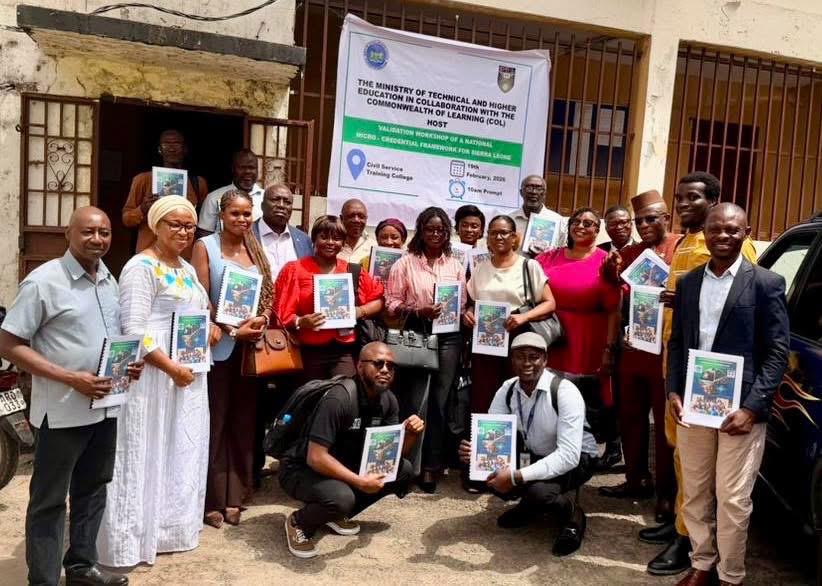
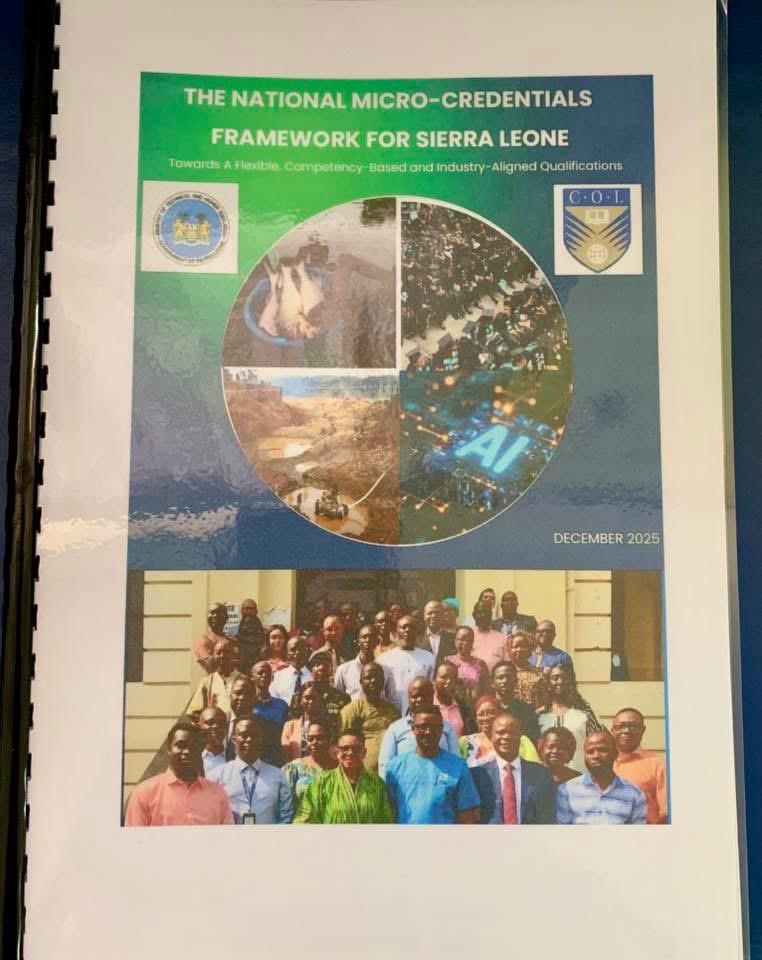
The Ministry of Technical and Higher Education (MTHE), in collaboration with the Commonwealth of Learning (CoL), has convened a hybrid workshop on the validation of Sierra Leone’s National Micro-Credentials Framework, a policy instrument designed to enhance flexible, competency-based and industry-aligned qualifications.
Delivering the opening remarks, Deputy Chief Technical and Higher Education Officer, Sia Fasuluku, traced the origins of the initiative to a regional engagement among Commonwealth countries, where stakeholders examined the need to modernize education delivery through shorter, modular training models. She explained that while traditional degree programmes remain relevant, the fast-changing demands of the 21st-century labour market require more flexible options that allow learners to acquire employable skills within months and progressively build toward higher qualifications.
She disclosed that out of 56 Commonwealth member states, six countries, including Sierra Leone and Nigeria, were selected to pilot micro-credential frameworks. Sierra Leone, she noted, is the first among them to develop a national framework.
She emphasized that the validation workshop aimed to review the framework in detail and confirm stakeholder consensus reached during earlier consultations in December. She added that the model would support Technical and Vocational Education and Training (TVET), while also creating opportunities for professionals seeking to upskill or reskill. The Civil Service Training College, she said, has been identified as a pilot institution, particularly as it transitions toward becoming a public service academy linked with universities and national training systems.
Representing the Minister of Technical and Higher Education, Chief Technical and Higher Education Officer, Dr. Josephus Brimah, underscored the strategic value of micro-credentials as “building blocks of knowledge and competencies.” He described the framework as a formal structure that standardizes short courses already being delivered across institutions, aligning them with national qualification systems.
According to Dr. Brimah, the framework introduces flexibility across both academic and technical education pathways, enabling learners to accumulate certified competencies over time. He highlighted its relevance for reskilling, upskilling, continuous professional development, and lifelong learning, particularly in response to evolving labour market demands.
Acting Administrator of the Tertiary Education Commission, Idrissa Sannoh, described micro-credentials as short, competency-based certifications that complement traditional degrees while responding directly to industry needs. He reaffirmed the Commission’s commitment to integrating micro-credentials into national qualification structures, strengthening quality assurance systems, and fostering institutional partnerships to ensure effective implementation.
Deputy Accreditation Officer of the National Council for Technical and Vocational Education and Training (NCTVE), Komba Moiwa, said the framework provides a structured system for designing, assessing, validating, and recognizing short-term skills programmes. He noted its potential to widen access for individuals who missed formal education while enhancing employability through competency-based training, workplace assessments, and industry validation mechanisms.
Commissioner of the National Youth Commission, Joseph Lahai, referred to the initiative as a critical intervention for youth empowerment, noting that young people constitute about 65 percent of Sierra Leone’s population. He said the framework creates inclusive pathways for skills recognition, whether gained through apprenticeships, short courses, or informal learning, aligning the country with global best practices in workforce development.
Vice President 2 of the Sierra Leone Chamber of Commerce, Eldeen Elba, commended the Ministry for adopting an inclusive consultation process. She said micro-credentials would promote agile skills development, strengthen industry alignment, and improve productivity by enabling targeted, workplace-relevant training. She called for sustained collaboration, awareness campaigns, and incentives to encourage private sector participation.
Director General of the Sierra Leone Local Content Agency, Fodeba Daboh, described the framework as a “game changer” that would ensure Sierra Leoneans gain verifiable skills and greater access to employment opportunities. He added that it would also support technology transfer by ensuring foreign expertise is systematically passed on to local professionals through structured training.
From the social inclusion standpoint, Maseray Brima, Liaison Officer of the Office of the Presidential Adviser on Social Inclusion praised the Ministry for integrating persons with disabilities into the framework’s design process. She urged stakeholders to ensure accessibility through braille documentation, soft-copy formats, and sign-language interpretation to guarantee equitable participation.
The validation session also featured a technical presentation by Dr. Victor Massaquoi, Principal of the Civil Service Training College, who guided participants through the framework’s structure. Stakeholders were given the opportunity to scrutinize its provisions and propose refinements ahead of full implementation.
Director of Higher Education at MTHE, Emmanuel J. Momoh, highlighted the framework’s alignment with national education objectives, noting its role in expanding access to practical, hands-on training alongside university education. He formally declared the document reviewed, authenticated, and validated as a legally binding national instrument.