
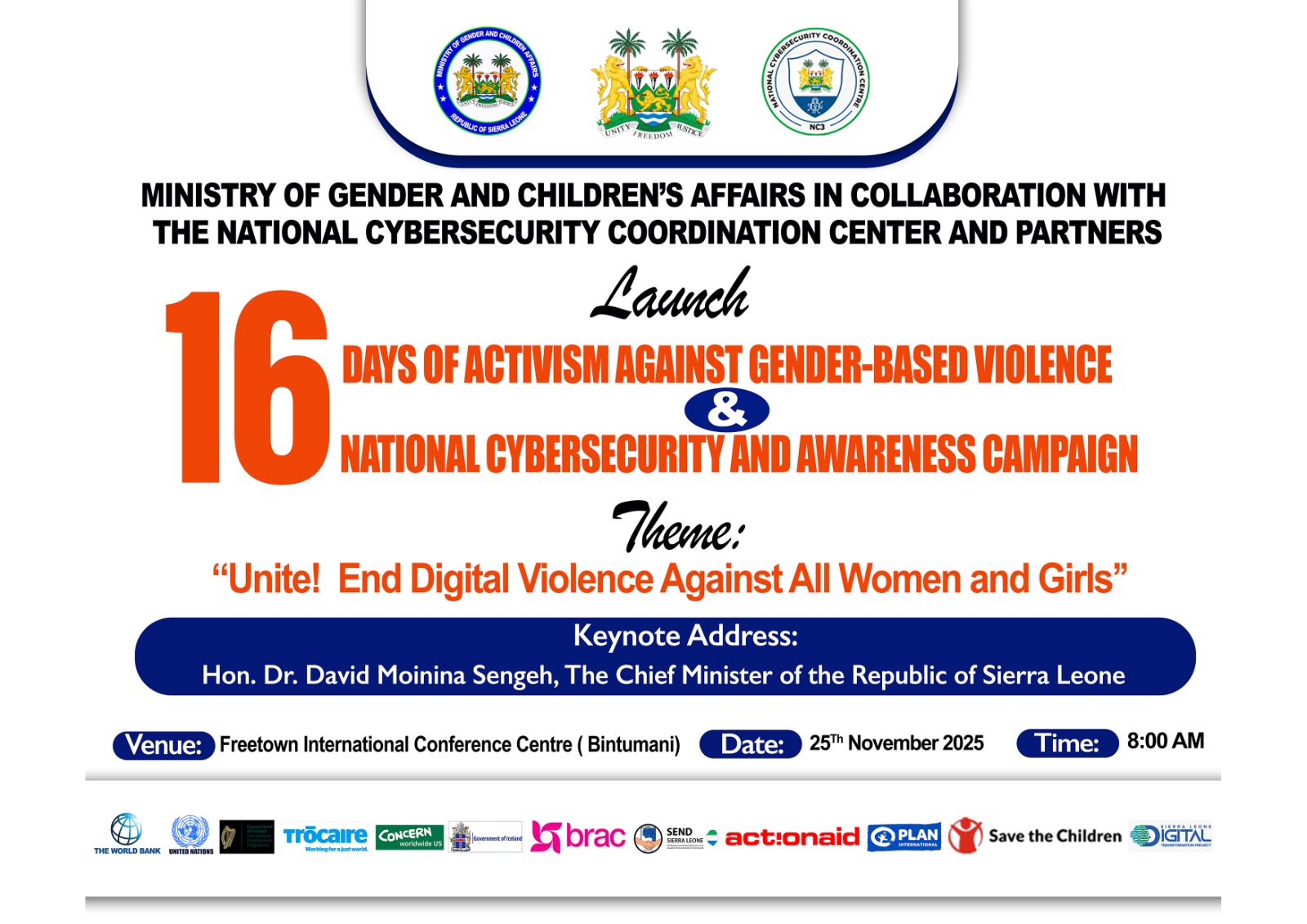
Sierra Leone will on 25th November 2025 join the global community in launching the annual 16 Days of Activism Against Gender-Based Violence, with this year’s campaign themed “UNITE to End Digital Violence Against All Women and Girls.” Running until 10th December, at the Bintumani International Conference Centre in Freetown.
The 2025 edition places strong emphasis on addressing rising threats of digital abuse targeting women and girls across the country.
The global campaign, initiated in 1991 by the Women’s Global Leadership Institute, connects the International Day for the Elimination of Violence against Women and International Human Rights Day. The 2025 observance aligns with the UN Secretary-General’s UNITE initiative and marks the 30th anniversary of the Beijing Declaration and Platform for Action, reinforcing the urgent need to confront violence occurring within digital spaces.
Sierra Leone has made significant progress in strengthening its legal and policy frameworks through the Domestic Violence Act (2007), Sexual Offences Act (2012, amended 2019), Gender Equality and Women’s Empowerment Act (2022), and the Prohibition of Child Marriage Act (2024).
The establishment of One-Stop Centers, the 116 Rape Helpline, Sexual Offences Model Court, GBV-IMS, and electronic referral systems continue to improve survivor-centered services nationwide. However, despite these gains, digital forms of violence ranging from cyber harassment and image-based abuse to deepfake pornography and online threats—remain poorly understood and inadequately documented at national level.
According to organizers, digital violence particularly affects women in public life including activists, journalists, and politicians, while rural women remain vulnerable due to limited digital literacy and access to safe technologies. Weak global legal frameworks further complicate justice and protection.
The national launch will gather key institutions such as the Ministry of Gender and Children’s Affairs, Ministry of Communication Technology and Innovation, Ministry of Information and Civic Education, Ministry of Technical and Higher Education, Ministry of Basic and Secondary School Education, Cyber Units of the Sierra Leone Police, National Cyber Coordination Agency, telecom operators, universities, schools, civil society organizations, UN agencies, and women’s groups. The event aims to create a unified national front capable of designing a holistic strategy that integrates prevention, protection, and policy reform.
Building on recommendations from the 2024 campaign, this year’s community engagement will focus heavily on university campuses targeting students from ten tertiary institutions nationwide. Youth leaders, who last year committed to peer support and community advocacy, will be mobilized once again to promote safe digital behavior and champion gender equality both online and offline.
Aim and Objectives
The overarching aim of the 2025 campaign is to position digital violence as a collective responsibility, mobilizing action from government, technology companies, civil society, youth, media, and international development partners.
Objectives include advocating for the criminalization of all forms of digital violence, strengthening law enforcement capacity, improving survivor access to justice, promoting digital literacy among women and girls, ensuring the safety of women in public life, and encouraging technology companies to adopt more transparent and victim-centered content moderation systems.
Key Activities (25 Nov – 10 Dec 2025)
National Launch Event
Media Advocacy across radio, TV, print, and social platforms
Community Outreach & Town Hall Meetings with local leaders and youth networks
School & University Sensitization focusing on digital safety, respect, and consent
Float Parade to amplify visibility and public solidarity
Expected Outcomes
The campaign is expected to increase public awareness of digital violence, strengthen advocacy for improved laws and policies, enhance coordination between government and civil society, improve digital safety skills among women and girls, and elevate the voices and experiences of survivors.
Key Partners
Major partners include the Ministry of Gender and Children’s Affairs, UN Women, the Directorate of Science, Technology and Innovation (DSTI), Ministry of Communication Technology and Innovation, women’s rights organizations, telecom companies, media houses, community leaders, and youth groups.
Monitoring and Evaluation
The campaign will employ pre- and post-awareness surveys, media monitoring, community feedback collection, documentation of survivor testimonies, and a comprehensive end-of-campaign review to assess progress and identify lessons learned.
As Sierra Leone advances toward a more digitally connected society, the 2025 campaign underscores a rising national priority: ensuring that women and girls can participate safely, freely, and equally—both offline and online.