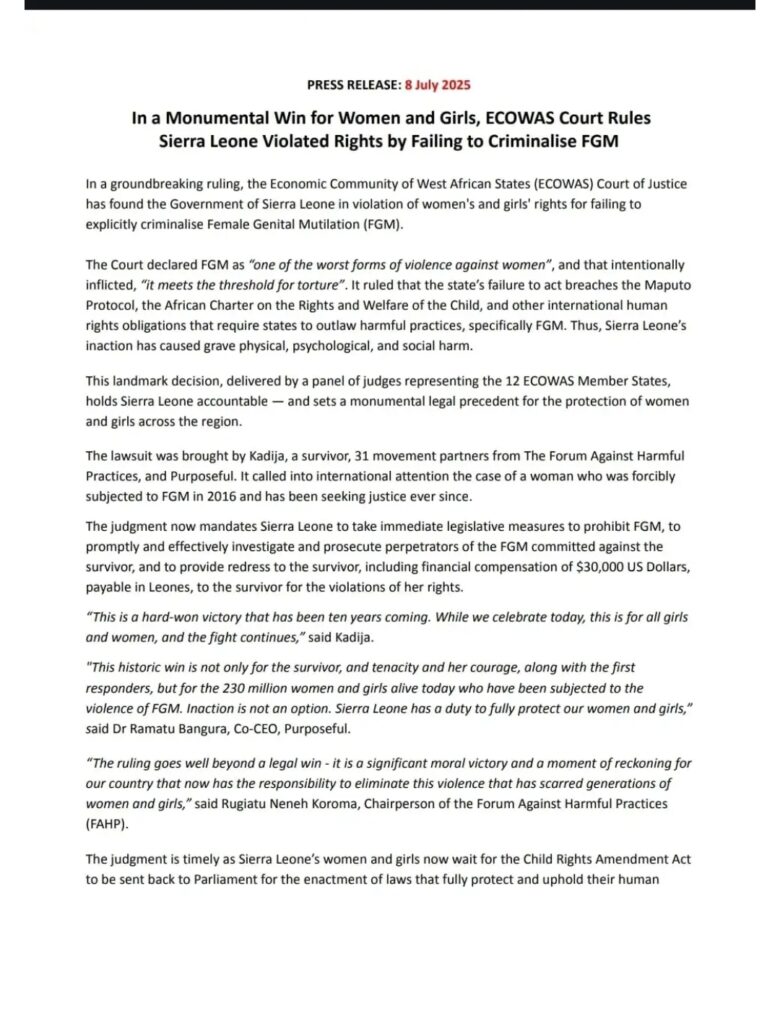

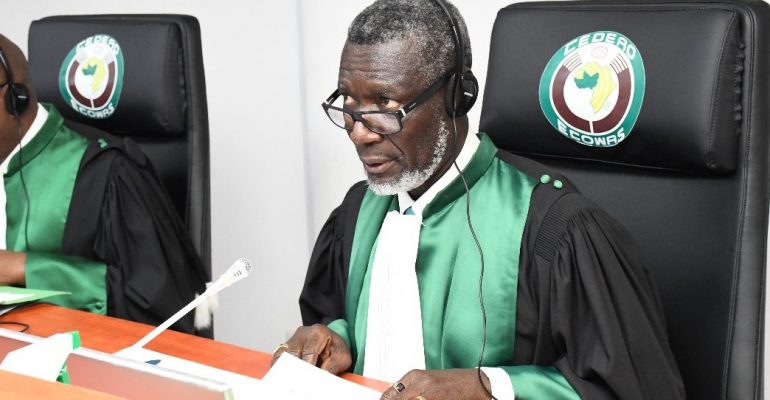
In a historic and precedent-setting decision, the Economic Community of West African States (ECOWAS) Court of Justice has ruled that the Government of Sierra Leone violated the rights of women and girls by failing to criminalise Female Genital Mutilation (FGM), describing the practice as “one of the worst forms of violence against women” and equating it to torture.
The judgment, delivered by a panel of judges representing the 12 ECOWAS Member States, marks a significant victory in the decades-long fight to end FGM. The Court found that Sierra Leone’s inaction breached key international and regional human rights treaties, including the Maputo Protocol and the African Charter on the Rights and Welfare of the Child. It held that the failure to outlaw FGM has caused grave physical, psychological, and social harm to women and girls in the country.
The case was brought before the Court by Kadija, a survivor of FGM, with the support of 31 movement partners from the Forum Against Harmful Practices (FAHP) and the feminist organisation Purposeful. Kadija was forcibly subjected to FGM in 2016 and has been seeking justice ever since.
In its ruling, the Court ordered the Government of Sierra Leone to immediately enact legislation to criminalise FGM, to investigate and prosecute those responsible for the act committed against the survivor, and to provide redress. The Court further mandated the government to pay financial compensation of $30,000 (USD), to be converted and paid in Leones, to the survivor for the violation of her rights.
“This is a hard-won victory that has been ten years coming,” said Kadija, the survivor who courageously led the case. “While we celebrate today, this is for all girls and women, and the fight continues.”
Dr. Ramatu Bangura, Co-CEO of Purposeful, hailed the judgment as “a historic win not only for the survivor, and her courage, but for the 230 million women and girls alive today who have been subjected to the violence of FGM. Inaction is not an option. Sierra Leone has a duty to fully protect our women and girls.”
Rugiatu Neneh Koroma, Chairperson of FAHP, added: “The ruling goes well beyond a legal win – it is a significant moral victory and a moment of reckoning for our country. Sierra Leone now has the responsibility to eliminate this violence that has scarred generations of women and girls.”
The timing of the ECOWAS Court’s ruling is particularly significant, as Sierra Leone awaits the return of the long-anticipated Child Rights Amendment Act to Parliament. Activists hope the ruling will galvanise lawmakers to enact laws that fully protect and uphold the rights of women and girls across the nation.
This decision by the ECOWAS Court sends a powerful message across West Africa, reaffirming that harmful traditional practices like FGM have no place in a society committed to upholding human rights.